与「Founder」相关的搜索结果
Founder 贴吧
一个关键词就是一个贴吧,路径全站唯一。
用户
未找到
包含 Founder 的内容

Some mornings quietly rearrange ambition. 🚀
At an @EYnews x Australian Chamber of Commerce joint event a few weeks ago, my NewChic Capital Family Office partners and I weighed in on a conversation about space as private capital's next frontier.
We backed SpaceX early, years ago. And the question that stays with me: how do we keep pursuing moonshots while staying practical?
Panelists Mahesh Harilela, Space HK co-founder, whose family created The Hari, and Dr Adam Janikowski brought real estate, manufacturing and data centre conversations alongside legacy and vision.
With my NewChic Partners, I found possibility. ✨
Which dream earns your conviction?
Christy So · Laurence Thoo
#SpaceEconomy# #FutureInfrastructure# #FamilyOffice# #HongKongInvesting# #PrivateMarkets#
显示更多


Why Tokenization Could Be the Most Important Economic Innovation of Our Lifetime | Bruce Fenton
@BruceFenton is a longtime Bitcoin advocate since 2012, securities professional, and one of the early pioneers of tokenized securities. He is the founder and CEO of Chainstone Labs and founder of Atlantic Financial.
Alongside Overstock founder @PatrickByrne, Bruce was involved in some of the earliest efforts to bring securities and financial-market infrastructure onto blockchain rails. In 2018, he tokenized equity in his own company, Chainstone Labs, on the Ravencoin blockchain—years before tokenization became one of Wall Street’s biggest narratives.
In this episode, Bruce breaks down naked short selling, the plumbing behind traditional securities markets, and why he believes much of the problem is ultimately a ledger problem. We dive into questions such as: Who actually owns the stocks sitting in your brokerage account? How can shares be lent and rehypothecated? What role do brokers, clearing firms, DTCC, and Cede & Co. play in determining who owns what? And could blockchain replace an opaque system of claims and intermediaries with a transparent ledger showing exactly where an asset is and who owns it?
We unpack what “tokenized stocks” actually means—and the important distinction between a token that simply gives you exposure to a stock’s price and a security issued natively onchain, where the token itself represents the actual share and the ownership rights that come with it.
Bruce discusses how tokenization could allow smaller businesses to tokenize ownership and have their stock traded globally without needing to be listed on a traditional exchange like the NYSE, as well as what a future without KYC could look like. Finally, we get into Wall Street’s embrace of tokenization, the SEC’s evolving approach to tokenized securities, and one of the biggest questions surrounding the future of this technology: who ultimately controls these new financial rails?
Remember to subscribe and hit the bell “🔔” icon to get notifications
0:00 Bruce Fenton & Patrick Byrne: Pioneers of Tokenized Securities
3:36 Naked Short Selling Explained
6:28 Who Actually Owns the Stocks in Your Brokerage Account?
12:00 Tokenization Solves Wall Street’s “Ledger Problem”
15:48 What Are You Actually Buying With Robinhood’s Tokenized Stocks?
16:48 Real Tokenized Stocks: When the Token IS the Share
21:46 Tokenization Could Open U.S. Markets to the Entire World
22:52 Why Companies May No Longer Need the NYSE
26:29 Could Tokenized Markets Exist Without KYC?
29:31 Bruce Tokenized Equity on Ravencoin in 2018
30:53 Will Blockchain Make Clearing Houses & DTCC Obsolete?
33:17 Could Tokenization Have Prevented the GameStop Crisis?
38:19 Wall Street Is Embracing Tokenization — Who Gets the Power?
40:20 The SEC’s New Tokenized Securities “Innovation Exemption”
42:57 Why Robinhood’s Tokenized Stocks Don’t Qualify
47:01 Could Everything Eventually Be Tokenized?
51:02 The Dystopian Side of Tokenization: Surveillance & Asset Seizure
显示更多

Higgsfield is the most untold story in tech.
$1BN in ARR in 18 months. Faster than everyone other than OpenAI and Anthropic.
They spend $4M a month on models. They expect this to be $100K per person per month.
They have 150 people working in a content machine.
They will breed more millionaires than any other company in Kazakh history.
For the first time, @alexmashrabov on the journey to $1BN in ARR. (below)
1. The Power of the Immigrant Founder
Coming from Uzbekistan, Alex was pushed into competitive programming at age eight as his single path to reach the United States. For international founders, placing top in global competitions serves as the ultimate social elevator, instilling the relentless work ethic required to build breakout companies.
2. My Biggest Lessons in the Journey to Finding Product-Market Fit
@higgsfield burned over $10 million of its $16 million seed round chasing hype and narrative rather than product quality. With under $5 million left, the team pivoted to product-led growth, solving camera control for creative directors, which immediately triggered organic hypergrowth without paid ads.
3. The 150-Person Content Team Powering Higgsfield's Billion in ARR
Nearly half of Higgsfield's workforce consists of 150 in-house creative professionals producing tutorials, ads, and cinematic projects. Generating 90 minutes of TV-quality AI video requires 100 hours of raw output, proving human taste and curation remain the primary drivers of distribution.
4. We Spend $4 Million per Month on Models
Higgsfield spends $4 million monthly on internal model usage, averaging $10,000 per employee so teams can freely vibe code and test workflows. Uncapped inference compute acts as a force multiplier, allowing top talent to discover breakthroughs at maximum velocity.
5. Why Chasing Benchmarks Is Bullshit and the Corporate Misalignment Occurring
Public benchmarks have devolved into corporate psyops where lab researchers overfit test data to secure bonuses before job-hopping. Text-to-video benchmarks ignore real production workflows requiring 3,000-word prompts, proving direct customer iteration beats artificial leaderboards.
6. Why Team Sizes Won't Be Impacted as Much as People Think
While AI handles over 60% of basic support requests, complex B2B environments cannot eliminate human teams. High product velocity constantly shifts rules and context, requiring smart, coordinated operators across legal and customer success.
7. Americans Are Way More Promiscuous When It Comes to Leaving Companies
Silicon Valley workers routinely jump jobs every two years, prioritizing short-term trends over deep commitment. This transactional market gives international hubs an advantage, where cultural loyalty and team stability build compounding technical moats.
(links in comments)
显示更多

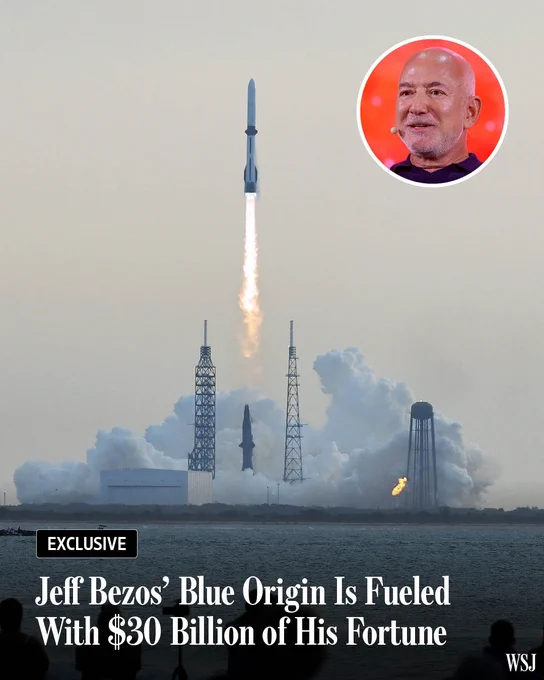
Exclusive: Jeff Bezos has invested $30 billion in Blue Origin since its founding in 2000, an extraordinary commitment from the founder in a company that aims to rival SpaceX.
显示更多

跟团队确认了下数据,AI交易产品SmartX (@SmartXTerminal) 的waitlist活动竟然都已经有3.3万的注册用户了!绑定社媒的就有1.8万。
对于AI social trading 平台而言,能够吸引到愿意带社交身份的 trader 就是核心竞争力。这次 campaign 无疑是对接下来的产品正式上线做了很好的铺垫。
大家看到的是 SmartX 这两天在 X 上刷屏,top KOL 们纷纷进行分享;没看到的是整个白名单活动设计的小巧思,以及团队没日没夜跟用户们一对一打了几十个小时的 call。
从GTM的角度来看,这场冷启动活动有太多值得分析的点了,提炼出一些来跟大家分享,希望对正在准备产品冷启动的朋友们有帮助:
1/ 团队在活动 launch 之前,花了非常多的时间来跟用户一对一的沟通,比如市场团队小伙伴甚至一天开十几个会。通过跟用户沟通,一方面是收集产品反馈,另外一方面也是建立了很好的用户信任基础,这样活动 launch 的时候,大家就能够在短时间内进行转发支持。
2/ 活动是以非常轻量化的形式进行呈现,大家通过回答问题来获得自己交易画像的分析。同时,这些分析结果也比较有意思,利于社媒的传播。
3/ 邀请机制与排名榜单并行,这样用户会更有动力邀请社区用户参与。
4/ 团队 founder @David_MetaWorld 和核心成员持续地与社媒上分享的用户进行互动,持续吸引曝光和构建信任。
5/ 对于社媒社交活动而言,设计的画风审美是非常重要的。这次活动画风设计审美也在线。
最后预告一下,JE Labs (@JELabs2024)和SmartX,以及其他非常顶的合作方,10月初在新加坡会有场线下活动,最近团队在持续加班准备中。See uuuuuu in SG!
显示更多


My first piece for @NewYorker is out today!
As Xi Jinping lands in DC to start his state visit, you'll hear a lot about the US-China AI race. I'd like to tell a complementary AI story.
This past May, a few days after Trump visited Beijing, I went to the town people call China's vibe-coding capital, Liangzhu. There, you learn that China's AI scene is not monolithic. It's also full of contrarians, cool vibe coders, spiritual seekers, and people who love AI but refuse to join the 996 grind.
Liangzhu is on the edge of Hangzhou. I hung out with a group of anti-mainstream builders who use AI to make whimsical apps for fortune-telling, mental well-being, and creativity. Some of them run their lives entirely by bazi astrology (their founder almost became a Taoist monk). They meet on "Crazy Thursday" to vibe-code together. Rent is cheap, so they can get a bigger place with a living room to have friends over (unthinkable in Beijing or Shenzhen). In Liangzhu, they want to use AI to forge their own future.
It’s a ground-level story—less about model capabilities, hyperscalers, or AI policy, and more about how people in China are using AI, and the human stories behind it.
显示更多


The World is Changing: AI For Creativity
By Jeffrey Katzenberg
A few months ago, I sat in my office in Silicon Valley and watched as a tech founder showed me something extraordinary. On the screen was a fully realized, beautifully lit, well-composed animated scene. It was stunning and it made me feel exactly what I felt in 1986 watching Luxo Jr. That was the first time I watched a computer-animated 3D character take a breath and seem, against all reason, to have life. It left me in awe.
Later that day, I received a text from an artist I've known for thirty years, 350 miles to the south, in the city where I spent most of my career. After seeing a similar video, she texted: "Is this the end of us?" My answer was, "Certainly not.”
I have spent the better part of the last decade in Silicon Valley, but the heart of my career has been in Hollywood. Being deeply connected to both worlds means I have deep loyalties to each and a responsibility to speak honestly to both.
In 2023, I said that these new AI tools would cut the time and cost of producing world-class animation by as much as ninety percent within three years. Some colleagues were alarmed, many were furious.
There is growing fear and resistance surrounding AI within the creative community. I deeply understand it, because I've spent countless hours walking through animation studios watching gifted artists bent over their desks, rebuilding a single second of film for the tenth time because the ninth version wasn't quite right. I've sat in screening rooms where four years of people's labor played out in minutes, and I knew the name of every person that had spent countless hours bringing those images to life. The creative process is a calling, there's really no other way to describe it. From the outside some see resistance. From the inside, it is love.
People do not fight this hard for things they don't care about. The pushback coming out of Hollywood represents the collective effort of people who are deeply passionate about their craft.
Is History Repeating Itself?
The history here is more complicated than either side may realize. In 1906, the most famous composer in America, John Philip Sousa, published an essay titled “The Menace of Mechanical Music." He warned that the phonograph would become "a substitute for human skill, intelligence and soul."
Sousa's fight was not really about the machine, it was about money. The machines were playing his compositions, and the men who built them weren't paying him a cent. His campaign helped create the Copyright Act of 1909. He did not stop the technology. He changed the terms under which it could use his work.
A hundred years ago, sound came to the movies. We remember it now as a miracle, and it was. What we forget is who paid for it. Before sound, tens of thousands of musicians made their living in the orchestra pits of movie houses, scoring every film live, every night, in towns all over the world. When the soundtrack arrived, the work of one composer and one orchestra was recorded for a film that went into thousands of theaters. The union fought back with everything it had, taking out newspaper ads across the country warning against the menace of "canned music," one of them showing a mechanical man tearing the strings out of a harp while an angel wept.
They were not fools, and they were not Luddites. They were right. Those pit jobs did not come back. And yet (this is the part we have to be brave enough to admit), sound gave us the movie musical, the modern score, sfx, sound design, audio engineering, and an art form vastly larger than the one it disrupted. And it helped keep Hollywood in the forefront of world entertainment for the rest of the century and into the next. The loss was real. And yet the art form expanded.
This is a story that has been told over and over again. To resist technology is to risk irrelevance. Just look at Kodak or Blockbuster. To embrace technology is to open doors of new possibility. Just consider Apple and Netflix.
What I Learned From Walt Disney
In the mid-1980s, I was tapped to lead Disney's animation division at a moment when the studio was at an inflection point. Animation wasn't just another business unit. It was the soul of the company, a medium revered because of Walt's genius and his passion. But the production system was cumbersome and unforgiving. A single movie was 125,000 individual hand-drawn and painted cels, photographed one frame at a time. Every revision carried a cost measured in months. These degrees of difficulty shaped the kinds of stories we could tell.
We found our way forward in an unexpected place: Walt himself. The Disney archives held astonishing recordings of Walt explaining his creative process. His own writings. His notes and storyboards. Work product captured at every stage of his process. This was truly a gift. Listening, reading, sitting with the work itself, we heard him talk about character, about emotion, about how an audience feels when a character truly comes alive. He talked about making bold choices and refining a scene until it genuinely moved people. We didn't hear a word about pencils or paintbrushes. In fact, Walt was famous for being a technologist, forever hunting for state-of-the-art tools, often inventing them himself to achieve the images he saw in his head. But he never defined animation by the tools. He defined it by whether the audience believed the character. His principles were timeless. The tools were not.
That realization changed everything. We co-developed the Computer Animation Production System (CAPS) with a young Northern California company called Pixar, replacing hand-painted cels with CGI. In The Little Mermaid, the final scene shimmered with a dimensionality and light that the old process simply couldn't achieve. In Beauty and the Beast, the ballroom sequence moved with a cinematic sweep that placed the audience inside the emotion of the moment. In Aladdin, the Cave of Wonders felt vast and alive, and the Magic Carpet became an intricate, compelling character all its own. In The Lion King, the stampede carried a scale and intensity that raised the emotional stakes beyond anything we'd done before. Technology didn't diminish the craft, it expanded the canvas. It gave artists more room to create.
A decade later, the canvas expanded again. When Disney released Pixar's Toy Story, it wasn't simply a technical milestone. It was proof that a fully computer-animated film could carry real emotional weight, that it could make audiences laugh, cry, and believe. At DreamWorks, we made the difficult decision to sunset hand-drawn animation and become a fully computer-animated studio. It was the right thing to do, but it was not without pain. It cost talented people their place in an industry where they had worked their whole lives. Some made the leap to the new tools and did the finest work of their careers. Some never did.
Tools are never the point. The instruments change with every generation. What endures is taste and imagination. The magical ability to make an audience feel. One of the greatest storytellers of our generation, George Lucas, succinctly captured the eternal essence of this issue: “It’s not the how, it’s the why.”
A Distinction With a Difference
I asked one of the leading AI models a question that has been challenging me for months. What is the difference between reasoning and creating? Its answer changed how I think about almost everything happening in this industry. It said . . .
Reasoning and creating are two distinct cognitive modes, though they also work together. Reasoning is fundamentally evaluative and analytical. It operates on what already exists: facts, premises, evidence. It moves toward a conclusion that was in a sense already implied by the input. Reasoning is constrained by logic and truth. Its goal is to arrive somewhere correct, not to invent somewhere new.
Creating is fundamentally generative. It produces something that didn't exist before. And crucially, there's no single right answer waiting to be found. A blank page has infinite valid responses. Creation involves choices that can't be fully justified by logic alone. Taste, intuition and vision fill the gap where deduction runs out.
Reasoning is what Silicon Valley has been perfecting. Creating is what Hollywood has been practicing for more than a century. AI today operates almost entirely on the reasoning side of the line. It can deduce, evaluate, optimize, and pattern-match brilliantly. And while it can create, there is a real distinction to being creative. What it doesn’t yet have is those things that make us human: empathy, devotion, serendipity, the kind of creativity that comes from a person trying to say something only they could say. When the bot generates a piece of art, it is not trying to communicate anything. It is statistics, not soul; it is emulating things that have been done. By contrast, human creativity isn’t about repeating patterns of zeros and ones; it is about doing something new.
One day, AI may close this gap. Three years ago, the leaders building AI would have called what they are achieving today, improbable, if not impossible. Impossible is no longer improbable.
Today, the line between reasoning and creating is real. Even the leading technologists acknowledge we are not there yet. There is no scientific path to crossing this divide that anyone in the field can articulate today. Understanding that gap is where we will find common ground.
A Path Forward
In 2016, I closed one chapter in Hollywood with the sale of DreamWorks and opened another in Northern California, co-founding WndrCo. We’ve backed more than 50 founders building the next generation of technology and watched how breakthroughs in Silicon Valley emerge, first as experiments, then as platforms, and finally as infrastructure that reshapes entire industries. It's worth remembering that the last great revolution in animation also came from the north. Pixar was a Northern California company, forged not in the conventions of the Hollywood studio system, but in the technological breakthroughs of Silicon Valley. I've spent years on both sides of this bridge. For sure, I don’t have all the answers (take Quibi, for one!). But, from my past and present vantage points of my long career, here is what I see . . .
Brilliant people in Northern California building this technology have made something extraordinary. They have earned the right for the rest of us to be, if not believers, at least optimistic that what comes next will be remarkable. But they have not made an artist. The tools are powerful, but they are not what makes a story matter. That knowledge lives 350 miles to the south, inside people whose life's work has informed the very models you are building. The right path forward includes them by design, with credit, with consent, and with compensation. Build this with the storytellers. Not on top of them. Taste is not something that can be synthesized, it is uniquely human.
At the same time, Hollywood needs to accept that AI is not going away. The energy they are spending trying to make it disappear is energy they are not spending deciding the terms on which it will exist. And the terms are everything. The north needs something from it that they cannot build and cannot buy: creativity. The kind that takes a blank page and conjures a single right answer where there was none and has held audiences for a century. Without it, the most powerful reasoning engine ever invented will still be missing the only thing that makes a story worth telling.
The artists who learn to wield these new instruments will do things the engineers never dreamed of. They always have. Edison invented the motion picture but made terrible movies. It took Chaplin, Lloyd, Keaton and so many others to make movies emotional. Now, the canvas is about to expand yet again. We should decide now that we intend to paint on it.
There are so many valuable lessons in history. This has happened many times before, and it was never settled by the technology. It was settled by the terms. Sousa did not stop the phonograph; he helped write the law that made sure composers got paid. And two years ago, when the writers and the actors walked out, they were fighting for the very things Sousa was fighting for in 1906. Consent, compensation, the basic recognition that human creative work has a price that must be paid. The terms of that fight are still being negotiated, but the principle is older than any of us.
The tools-versus-no-tools argument is a trap. First, we must all agree that there should be terms. Then we can have the crucial debate about what fairness requires.
What I Learned From Steve Jobs
Years ago, Steve Jobs said, "It's in Apple's DNA that technology alone is not enough. It's technology married with the liberal arts, married with the humanities, that yields us the result that makes our hearts sing." He was describing a device. But he could just as easily have been describing this tale of two cities.
What I See Coming Soon
As the barriers and the costs come down, more films will get made, not fewer. Studios will get to take more risks. There will be more seats at the table, and very soon entirely new forms of storytelling. In the 1980s, animation was dismissed as a niche corner of the business. Today it is one of the most beloved and profitable forms of storytelling in the world. In live action, filmmakers like Steven Spielberg, James Cameron and Peter Jackson embraced new visual tools not as shortcuts, but as instruments, and expanded cinema in the process. Every time storytelling has met a genuine technological shift, from synchronized sound to color to computer animation, it has redefined the boundaries of the medium and grown larger in the process.
Assuredly, I don’t have all the answers, but I am confident that the creative opportunities will expand yet again. How we come through this is a choice. The north has the new tools. The south has the creative soul. The best future will draw on the best of both worlds.
显示更多

Grok Bot Communities are live
Group chats on X for Product, Engineering, Design, Marketing, GTM, Recruiting, Founders
Apply here:


A look at some top Variational points whales:
1. Contessa — $8B+ personal volume; heavy daily trading since last year; low-key
2. @linenmito — whale trader, HYPE OG, +1,311 BTC on BitMEX
3. @TaikiMaeda2 — well-known KOL / directional trader; $4M+ PnL on VAR; ETH & ZEC whale
4. @Metabape — CN community influencer; large-size arb trader; ~$30B personal + referral volume
5. Unknown — likely #3# by volume; wallet ending 558e
6. @lynn000333 — me; VC / equities background; still relatively new to crypto
7. @derteil00 — Panda community founder; HYPE OG, LIT points #3#; perpdex triple crown
8. Unknown — likely #11# by volume; wallet ending 91db
9. Unknown — likely RealBatman; multi-perpdex arb; +$2M PnL, ~$850M volume
10. @CryptoMadbad — HYPE whale / size trader
(ranks 3–5, 8-9 may be slightly off, corrections welcome)
Most plan to hold points long-term. Top 2: 80k+ pts. Top 5: 40k+. Top 10: 30k+. Together ~500k pts (~6%)
Also on the platform: @Cbb0fe @izebel_eth @MomentumKevin @KookCapitalLLC @poorlydrNFT @hansolar21 @Henrik_on_HL and so on
stacked lineup
显示更多


I asked people: "which data companies should an ambitious future founder join?"
13 votes: Mercor (@BrendanFoody @adarsh_exe @suryamidha)
11 votes: Fleet (@nicoup @andrewthezhou)
10 votes: Proximal (@MatternJustus @navidkpr @calvinchen)
9 votes: Surge (@echen)
8 votes: AfterQuery (@CarlosGeorgescu @spencermateega)
7 votes: Mechanize (@GuiveAssadi @tamaybes @EgeErdil2 @MatthewJBar)
6 votes: micro1 (@aliansarinik)
4 votes: Datacurve (@serenaa_ge @charleyslee)
4 votes: OpenAI (data team) (@BarrAlexandra @phoebethacker)
4 votes: Preference Model (@Ning_Catsnail)
3 votes: Bespoke Labs (@madiator @AlexGDimakis)
2 votes: Anthropic (data team)
2 votes: Datology (@arimorcos @hurrycane @leavittron)
2 votes: Long Lake (@alextaubman @rasmuswissmann @varunshenoy_ @tarasholovko)
2 votes: Sieve (@mokshith @thpicy)
People couldn't pick a company they work at or founded. Disclosure: I'm a small investor in AfterQuery and Fleet (in this post), and in Abundant, Applied Compute, Latch, Olam Labs, Trajectory and Vmax (elsewhere on the list). I didn't vote.
显示更多
