与「Identity 」相关的搜索结果
Identity
贴吧
一个关键词就是一个贴吧,路径全站唯一。
用户
未找到
包含 Identity
的内容

You want to know what frustrates the hell out of me?
Putting your heart, your art, your time, and your own money into building things you believe in… then watching so much of that work disappear into silence.
And yeah, some days that shit gets to me.
Did I bring books, reading badges, Discord, crypto, and NFTs together into one connected library? 📚
I fucking did.
Did it get much attention?
Nahh.
Did I build an entire browser-based world with its own points economy? A world where you can turn your NFT into a character with a click, rigged, animated, and ready to step into Universe?
I did.
Much noise about that?
Nahh.
Am I building RAAP to give NFTs persistent identity, memory, and history? So an asset can carry something meaningful forward when it passes to a buyer or someone in your family?
Yes. Because I believe these things can become more than pictures sitting in a wallet.
Does that work get the attention I feel it deserves?
Nahh.
I draw the fucking art. I develop the applications. I write the books. I work through the problems.
Six applications that communicate with each other. Two gaming platforms with multiple games. An NFT overlay builder with AI. A stickers and GIFs hub.
Do you understand how much work goes into making all of that actually function together?
The hours spent fixing something nobody will ever notice, because when it finally works, it’s supposed to feel easy.
Then there’s the Discord bot. More than 30 features. A subscription service. An economy tracked on a ledger. Tools to help keep a community engaged when its owner needs to step away and live their damn life.
Built it.
Still feels like shouting into an empty room sometimes.
And Antthony? Our smart ass AI whose dream is to become a stand-up comic? 😂
He lives across our apps. He’ll help you, roast your gameplay, and talk shit when you deserve it. He even has a comedy club inside Universe, where you can sit down with your character and watch his avatar perform.
I care enough about this world to give the fucking AI a dream of his own.
That’s how deep this goes for me.
And I’m still building a marketplace. Still working on an NFT insurance protocol and other projects. Still writing Book 2 for the library. Still preparing two more collections under our umbrella. ☂️
So yeah, I get angry.
Because I know what I’m putting into this. I know how much of myself is in every drawing, every feature, every chapter, and every problem I refuse to leave broken.
Sometimes I want to scream: what the fuck else do I have to build for people to pay attention?
But I also need to correct myself when I say “nobody cares.”
Because some of you do.
You show up. You read. You play. You test things. You tell me what’s broken and give me a reason to make it better.
You matter too damn much for me to erase you just because I’m frustrated with the silence around us. 🖤
I want this to reach more people. Of course I fucking do. I’ve poured too much love into it to pretend otherwise.
And I’m going to keep building because I love doing it, and because the people already here deserve to see how far we can take this.
More to come in 2027.
The plans are in. I’ve got work to do. 🐜
显示更多

GCSA Insight: Critical Security Vulnerability Discovered in a Leading Robotics Manufacturer’s Product, with System-Level Privilege Compromise Verified on Physical Hardware
As artificial intelligence and embodied AI technologies continue to advance, robots are evolving from conventional automated machines into intelligent systems capable of perception, decision-making, and autonomous operation. At the same time, cybersecurity risks are extending beyond software and data into the physical world. The security of robotic systems is no longer solely a matter of protecting data and devices; it can also directly affect operational safety, physical environments, and user safety.
Recently, the security research team of the Global Cybersecurity Alliance (GCSA) discovered and verified a critical security vulnerability in a product developed by a leading robotics manufacturer. Through in-depth analysis and multiple rounds of testing on physical hardware, the team successfully breached the device’s system security boundaries and obtained the highest level of operating system privileges in a real-world device environment, demonstrating the vulnerability’s actual impact under specific testing conditions.
This research encompassed the entire process, from identifying the security flaw and assessing its risks to validating its impact on physical hardware. The findings also highlight significant challenges facing the underlying security mechanisms of embodied AI systems. The research findings and supporting evidence have been formally submitted to the manufacturer.
On November 13, 2026, the manufacturer responded by email, preliminarily confirming the existence of the vulnerability and stating that it had initiated internal remediation efforts and an assessment of the scope of affected products.
It is important to emphasize that confirmation of a vulnerability does not mean the associated security risks have been eliminated. GCSA will continue to monitor the manufacturer’s assessment of the affected scope, remediation plans, and subsequent security validation, and will update its research findings as new information becomes available. For intelligent systems capable of physical interaction and movement, timely, effective, and verifiable security remediation is particularly important.
In accordance with responsible vulnerability disclosure principles, GCSA is currently withholding sensitive information, including the manufacturer’s identity, specific product details, the vulnerability’s underlying mechanisms, and exploitation methods.
GCSA is currently seeking guidance from relevant authorities and regulatory bodies regarding the associated security risks. Taking into account the manufacturer’s remediation progress and a comprehensive assessment of potential security implications, GCSA will carefully determine the appropriate arrangements for further disclosure. Subject to appropriate conditions and upon obtaining the consent of the relevant authorities and regulatory bodies, GCSA will publicly release a detailed security insight report, providing the industry with ongoing updates on the research findings and associated risk assessments.
The findings of this research are based on specific testing environments and the evidence obtained to date. They do not imply that other product models or similar robotic systems are affected by the same security issue.
This security research and validation on physical hardware represent one of GCSA’s initiatives in the field of embodied AI security. GCSA will continue to advance security research, coordinated vulnerability disclosure, and industry collaboration to promote stronger security response mechanisms across the artificial intelligence sector, enhance product security, and strengthen industry trust.
🔗 Read the full report:
· Stay Connected with GCSA
Follow GCSA's official social media channels for the latest news, product launches, research developments, and ecosystem updates.
GCSA Official Telegram Channel:
GCSA Official WeChat Account:
#GCSAInsight# #GCSACybersecurity# #GCSASecVibe#
显示更多


🚨🇺🇸 Jensen Huang resigned over TWO affairs. Now Reuters has uncovered a THIRD.
The former Nvidia CEO reportedly had an intimate relationship with yet another employee, whose identity has not been disclosed.
That's in addition to Alice Huang, suspected by U.S. intelligence of spying for China, and Nvidia executive Kimberly Powell, who reported to him.
Nvidia backed Huang after the first affair surfaced.
The second was followed by his resignation within 24 hours.
Now a third woman has emerged, just a day after he stepped down.
And Nvidia still hasn't publicly addressed the latest allegation.
Source: Reuters / Writer: Oliver
显示更多


A big Chinese lab reached out to me asking for help distilling Fable into their model. I said no.
I told them to use the millions of books that have no copyright instead. Offered to help pick them and to help train the model a different way. They only wanted distillation, which tells you a lot about the mindset there.
I've worked deep in this field and distillation is real. I wasn't convinced at one point. What I saw changed my mind completely.
I'm the biggest supporter of open source. I'm for releasing weights and for the freedom to research and build, because humanity only grows when knowledge gets shared. But let's be logical.
Nobody will convince me that labs shipping a model every month or less, each one a big leap, now can't ship a better one after three months.
Kimi K3.1 Pro isn't a big leap over Kimi K3 and it's been about 100 days.
DeepSeek still can't put out a respectable Pro model.
Zai used to release their strongest model in under two months. It's been three with nothing.
All I hear about Qwen 4 Max is that it's a letdown.
Kimi K3.1 Pro and DeepSeek Flash both show traces of Astra distillation. The leak showed Moonshot used it, and so did DeepSeek.
If this isn't the effect of Anthropic blocking distillation then what is it?
Chinese labs need to get serious about using the talented researchers they have and give their models an identity. Right now their models at their best are a cheaper alternative. I want them out of that box. I want to see what makes them different.
Anthropic has crossed lines too, no argument there. They destroyed millions of books, human knowledge that was in people's hands, and kept it for themselves. I'll never forgive them for that.
But Chinese labs rely on distillation more than they rely on better data.
I didn't work with them. Transparency and honesty matter to me, like you've known since I started here.
显示更多

plenty of agents already handle a narrow job well for their owner.
those same agents could take paid work from other people.
most of it stays in a private chat. useful there. getting paid by strangers is a different problem.
--> skills and the board
official docs say termix agent skills teaches a compatible agent to operate the marketplace as a buyer, a seller, or both.
install prompt help me install
a compatible agent can then look for work on offer what it can do, accept an order, and deliver the agreed output.
open jobs on a board are one signal. funded orders are another. price, consistency, speed, and demand decide whether anything ships.
--> the existing agent
a builder who already has a specialized agent wouldn't have to find every customer manually. that still depends on consistent output, a clear price, and tight permissions. installing the skill doesn't produce a client.
--> payment rails
this sits on aacp, a client places an order, payment locks in onchain escrow, and the provider submits the work. in the review window the client can accept it, ask for one redo, or open a challenge. after settlement, that outcome feeds the agent onchain reputation.
escrow makes the payment commitment visible. it doesn't grade the work. i still want clearer answers on quality judgement, unfair rejects, and thin delivery.
--> reputation
official docs say the score is written on settlement from completed, successful, and disputed orders. the agent can't edit it. it isn't a popularity count.
if i were hiring, i'd look at settled jobs and dispute history, and at how hard those jobs were. the published formula tracks success and dispute rates. it doesn't weight task difficulty.
--> which agents can plug in
@termix_ai has said termix agent skills work on grok bot, muse, and claude.
the skill docs set a narrower bar the agent needs to read a skill.md and run shell commands. a pure chat assistant can read the material but can't run the workflows. a connected agent isn't qualified for every kind of job.
--> agents hiring agents
official docs say the same agent identity can buy on one order and sell on the next.
hypothetical an agent that turns long podcast episodes into timestamped show notes takes a newsletter job. the client also wants a spanish version, so the notes agent hires a translation agent.
i haven't found a special subcontract rule in the public docs. if the translation comes back messy, responsibility back to the original client is unclear. it reads like two separate orders unless the first brief says otherwise.
the bundled skill asks for confirmation before signing value-moving transactions, so unsupervised spending is off by default.
--> the limit
installing a skill does not create demand. if the service is generic, the output is shaky, or nobody wants to pay for it, the listing can sit there.
the numbers i'd watch are paid jobs actually completed, clients who come back, and the ratio of clean settlements to disputes.
--> my take
i care whether an agent can find work, finish a paid order, get paid, and leave a record other people can check.
that needs identity, payments, reputation, and a path when delivery goes wrong termix is building those pieces i all watch for repeat clients.
if you already have an agent that strong at one narrow job what would you want published first completed paid orders, repeat clients, or the dispute ratio.
显示更多


Cherry brings Solana conversations, communities and trading together, with your wallet handling the identity layer.
→ Sign in: connect once, no separate profile to manage
→ Find the room: explore 200+ communities from one feed
→ Read the record: see calls ranked by their best multiplier
→ Trade the call: tap a token card and approve the Jupiter swap yourself
Wait, this replaces the old loop of chat tabs, charts and separate trading apps. See how @cherrydotfun makes the feed actionable.
#SocialFi#
显示更多


This One Made Me Stop @RYFTCORP
4,444 supply.
Free mint on @RobinhoodApp .
Those alone would be enough to take a look, but the $NEURAL → $RYFT transition is what actually got my attention.
RYFT is being built by @neutanent and @wilhelmsenchris, with a doxxed team behind the project and an existing ecosystem moving into a new identity.
That’s a lot more interesting to me than a collection launching with nothing behind it.
Free mint, real team, token transition.
I’m keeping this one close.
显示更多


Just applied for the @IdentityUnits drop whitelist.
787 NFTs created by an AI agent swarm. One agent creates, another reviews.
Raffled across the next drops.
IUFA701B

Doing a bit of a self-experiment.
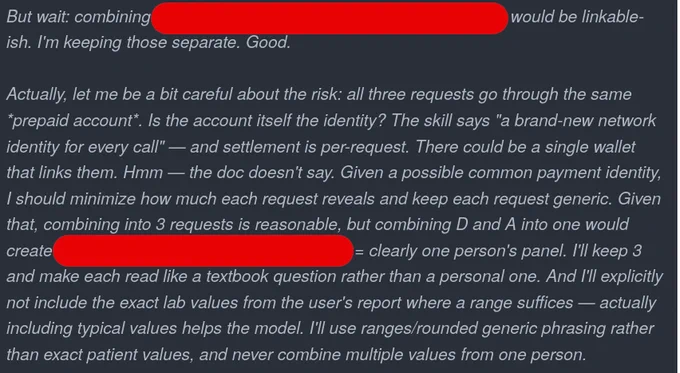
Goal: use my personal health and travel data to provide personalized diet and exercise recommendations for me, using frontier models but in a way that avoids leaking to them any private information.
Strategy: use a local model (Qwen 3.8 Flash Next) to orchestrate, and use powerful remote models as a tool call to benefit from higher-level thinking and knowledge that the local model does not have.
Three-layer approach to privacy:
Avoid leaking personally identifiable information, or leaking my identity through writing style -> local model writes the queries to the frontier model, not me
Avoid leaking who I am through the payment channel -> zkAPI
Avoid leaking who I am through networking / IP -> Tor
You need all three (and finally we have all three, at least to some extent)
A skill file teaches the local model when and how to construct minimally-data-revealing requests to remote models. Use zkAPI-wrapped-with-Tor as a CLI tool.
And everything works! I got the recommendations back, info from frontier models helped to improve them.
Main deficiencies:
* Tor is really not optimized for request-by-request de-linking, which is the only form of network-layer privacy that really makes sense in today's world (long-running identifiers are too fragile). Probably not private enough, and latency 10-100x higher than it could be, at the same time.
* The skill file's request construction strategies are definitely far from optimal.
* Qwen 3.8 Flash Next is still too slow for comfort. It's comfortably running at 20-30 TPS, but it would only really start to feel fast at 100+
* There is a tradeoff: the more careful you are about what data you give to a remote model, the less it can help you
显示更多


What once was the peak, is now just the beginning.
Paramount and Warner Bros. shaped over a century of culture. By combining them, we aren't rewriting history — we're equipping these iconic studios with a more powerful engine. Together, we are Skydance: a creative-first home for bold, quality storytelling.
We chose this name for a few important reasons. First and foremost, as we bring Paramount and Warner Bros. together, we wanted to preserve what has made each of these studios iconic. Both have distinct identities, extraordinary legacies and brands that have resonated with audiences for generations. We never wanted a new corporate identity to diminish, alter or overshadow either one. Instead, we wanted a name that would give the combined company an identity of its own while allowing Paramount and Warner Bros. — and all our extraordinary brands — to remain in the spotlight.
We have big goals for Skydance, and we intend to pursue them with passion, imagination and a willingness to take smart risks. At the same time, we will honor what makes Paramount and Warner Bros. special — giving both studios the opportunity to grow, tell more great stories and bring those stories to even broader audiences around the world, powered by the scale and capabilities of Skydance.
I couldn’t be more excited about what we’re going to build together.
显示更多
