与「Rendering」相关的搜索结果
Rendering 贴吧
一个关键词就是一个贴吧,路径全站唯一。
用户
未找到
包含 Rendering 的内容

Ranked No. 1 in benchmarks. Lightning speed. Native A/V sync.
The era of waiting in line for AI video is over. HappyHorse is now live on Alibaba Cloud Model Studio. Done while others are still rendering.
显示更多

Upgrade your agent with the swarm power of 3M+ real devices across 190+ countries: multi-engine research, multi-region verification, real-device crawling, geo-unblocking, and full JS rendering.
Your OpenClaw earns rewards while you sleep!
🎁 Bonus: 5,000 free AI credits/month
显示更多

Introducing @𝚠𝚝𝚎𝚛𝚖/𝚐𝚑𝚘𝚜𝚝𝚝𝚢
Ghostty for wterm
DOM-native terminal rendering
Full VT powered by libghostty
→ browser primitives just work
→ easy to extend and integrate
→ drop-in components for React, Vue and vanilla JS
显示更多


Multilingual & Text Rendering in ChatGPT Images 2.0, demonstrated by @BoyuanChen0


We just dropped Nano Banana Pro, built on Gemini 3. 🍌
With state-of-the-art text rendering, vast world knowledge and studio-quality creative controls, Gemini 3 Pro Image can create and edit more complex visuals, infographics and more. Here’s what’s under the hood. 🧵
显示更多


There have been a lot of crazy many-camera rigs created for the purpose of capturing full spatial video.
I recall a conversation at Meta that was basically “we are going to lean in as hard as possible on classic geometric computer vision before looking at machine learning algorithms”, and I was supportive of that direction. That was many years ago, when ML still felt like unpredictable alchemy, and of course you want to maximize your use of the ground truth!
Hardcore engineering effort went into camera calibration, synchronization, and data processing, but it never really delivered on the vision. No matter how many cameras you have, any complex moving object is going to have occluded areas, and “holes in reality” stand out starkly to a viewer not exactly at one of the camera points.
Even when you have good visibility, the ambiguities in multi camera photogrammetry make things less precise than you would like. There were also some experiments to see how good you could make the 3D scene reconstruction from the Quest cameras using offline compute, and the answer was still “not very good”, with quite lumpy surfaces. Lots of 3D reconstructions look amazing scrolling by in the feed on your phone, but not so good blown up to a fully immersive VR rendering and put in contrast to a high quality traditional photo.
You really need strong priors to drive the fitting problem and fill in coverage gaps. For architectural scenes, you can get some mileage out of simple planar priors, but modern generative AI is the ultimate prior.
Even if the crazy camera rigs fully delivered on the promise, they still wouldn’t have enabled a good content ecosystem. YouTube wouldn’t have succeeded if every creator needed a RED Digital Cinema camera.
The (quite good!) stereoscopic 3D photo generation in Quest Instagram is a baby step towards the future. There are paths to stereo video and 6DOF static, then eventually to 6DOF video.
Make everything immersive, then allow bespoke tuning of immersive-aware media.
显示更多


We just shipped LaTeX rendering for mathematical expressions in Google AI Studio, making it easier to test the SOTA math capabilities in our latest Gemini models 🧮 🚢


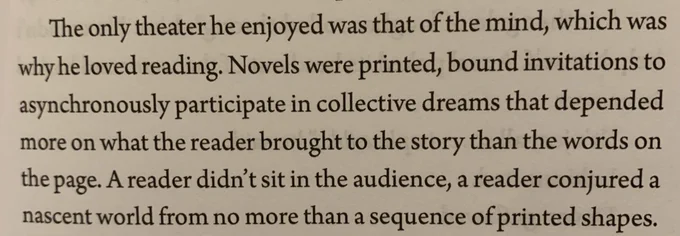
This paragraph from @eliotpeper’s book REAP3R makes me think about all the DALL-E renderings going around.