与「construction」相关的搜索结果
construction 贴吧
一个关键词就是一个贴吧,路径全站唯一。
用户
未找到
包含 construction 的内容

NVIDIA released Auto Ontology, an open-source library that builds a semantic layer from your enterprise metadata and exposes it to agents via MCP. Vendor tests claim **90% faster ontology building**.
The problem is familiar: agents that write SQL against your data use their own definitions, not the enterprise's. A "revenue" the agent calculates doesn't match the one in the financial report.
Auto Ontology builds a semantic layer from existing metadata (schemas, tables, columns, relations), reconciles definitions across systems, and exposes it to agents via MCP, CLI, or API. Nine MCP tools are provided to query the catalog, validate a query, or retrieve certified definitions.
What the account takes from this: the 90% gain comes from NVIDIA's own tests, not an independent measurement. The library automates construction, not governance. Business definitions, access rights, and auditing remain your responsibility.
The gesture: clone the repository, point it at a test schema, and see what entities and relations it extracts. The README shows the complete flow in ten minutes.
显示更多


BREAKING: SpaceXSI completes MiniHard construction in just ~5 months, with Gun Range targeting a ~4-month build.
According to SemiAnalysis, SpaceXSI is roughly halving construction timelines while most comparable projects face 8–12 month builds.
• MiniHard: Construction finished in approximately 5 months.
• Gun Range: The new site just south of the Tennessee–Mississippi state line is targeting approximately 4 months of construction.
• Colossus 1: Its first retrofit delivered 150 MW of capacity in 122 days.
• Colossus 2: A subsequent retrofit delivered 210 MW in just 91 days.
• Project SPAM: Work started October 5, with the first capacity targeted for December.
• Massive expansion: SemiAnalysis projects the Memphis–Mississippi campus will grow from 0.4 GW of IT capacity in January to 2.4 GW by the end of 2026. That would be a sixfold increase in one year.
• Five major projects: The expansion spans Macrohard, MiniHard, Macroharder, Project SPAM and Gun Range.
• Tesla powering the scale: SemiAnalysis reports 1,377 Tesla Megapacks across Colossus 2, providing nearly 6 GWh of battery storage.
The construction timelines and capacity forecasts are SemiAnalysis estimates, with future milestones still targets.
Elon Musk’s teams are bringing extraordinary speed and scale to the infrastructure powering AI.
显示更多


SpaceX has just unveiled a massive new $50 billion Supercomputing Campus that they want to build in Cochise County, Arizona.
All info:
• Up to 6 GW across the 9 supercomputing buildings
• Construction starts 2027
• Size of each supercomputing building: ~493,000 square feet.
• Total supercomputing building space: 4.44 million square feet, excluding support facilities.
• SSVEC residential customers are projected to see electricity bill reductions of 10–40%.
• Up to 24 GWh of grid-connected battery storage to provide backup power, stabilize the regional electric grid, support local voltage, and absorb fluctuations in electricity demand. Among the largest planned battery installations in the United States.
• Additional solar generation in the region is planned to supply renewable electricity during the day and reduce demand on the local grid.
• No dedicated on-site power plant or fuel storage yard is planned.
• Each supercomputing building will have 10 MW of natural-gas-powered standby generation for critical equipment, operating only during utility outages and periodic testing.
• No gas turbines will be installed at the site.
• SpaceX plans to fund $3.6 billion in grid infrastructure upgrades, transferred to AEPCO at no cost to its members.
• Up to $260 million annually in additional benefits for cooperative members at full buildout, on top of residential bill reductions.
• Up to $200 million annually for cooperative members statewide, in addition to SSVEC benefits.
• The supercomputers will use dry cooling with a closed-loop water circulation system rather than evaporative cooling.
• SpaceX projects zero ongoing industrial water consumption.
• The cooling system will be filled initially, with water reused for up to 10 years.
• SpaceX estimates annual water usage equivalent to approximately 20–30 Arizona residential homes.
• Projected annual water use would be less than 2.5% of a single center-pivot irrigation system's annual consumption.
• Permanent jobs: Approximately 1,000.
• Construction jobs: Approximately 5,500.
• Annual property tax revenue: Up to $103 million in estimated new annual revenue.
• Regional economic benefits: SpaceX says its investment will support public education, infrastructure, essential local services, and economic development.
• Local suppliers: SpaceX is encouraging suppliers to participate in construction and development of the campus.
• Noise mitigation: Equipment will be positioned away from neighboring properties where possible, with setbacks and additional screening to reduce noise.
• Nighttime lighting: Outdoor lighting will remain off unless work is underway, with active lights shielded and directed downward.
• Dark-sky protection: The campus will comply with Cochise County's dark-sky requirements to limit light pollution.
• Nighttime construction: SpaceX says it will seek waivers when nighttime construction lighting is necessary.
• Wildlife protection: The campus is being designed with consideration for the region's sandhill crane wintering habitat.
This campus's purpose is to build one of the world's most advanced AI supercomputing campuses to train SpaceX's superintelligence models and support scientific and engineering breakthroughs.
Learn more:
显示更多



Development of the Starbase supercompute site is creating an opportunity to address decades of environmental neglect.
Portions of the property were used for unauthorized dumping dating back to the 1960s. We're undertaking cleanup efforts to remove decades of accumulated debris, including scrap metal, discarded appliances, old tanks, fiberglass insulation, construction materials, and thousands of illegally dumped tires
显示更多


NEW: President Trump dances his way off stage to "Y.M.C.A." after delivering remarks at the Bethlehem Sparrows Point Shipyard in Baltimore.
The president brought his signature moves to the stage after highlighting the launch of construction on what he says will be the largest new U.S. shipyard since World War II.
显示更多


U.S. Based Rare Earth Company Winner Water to Join SPD and Mobix Labs (Nasdaq: $MOBX) National Security Matters Initiative
Federal awards totaling $53 million have propelled Winner’s technology from laboratory chemistry to a demonstration plant under construction
NEWPORT BEACH, Calif.--(BUSINESS WIRE)--Special Project Delivery, Inc. (“SPD”) today announced it has entered into a definitive Business Combination Agreement, dated September 30, 2026, with Winner Water Services Inc. (“Winner”), a revenue-generating U.S. rare earth company, under which Winner will join the National Security Matters (NSM) platform SPD is assembling with Mobix Labs, Inc. (Nasdaq: MOBX).
SPD is itself party to a definitive agreement with Mobix Labs, announced August 13, 2026, to combine the two companies as part of Mobix Labs’ NSM initiative, which focuses on U.S. national security priorities across defense and aerospace electronics, advanced RF sensing subsystems, rare earth elements and critical minerals, and energy and critical infrastructure. Winner is the first operating company to join that platform through SPD.
Winner is a Sharon, Pennsylvania-based company formed in 2013 as a joint venture with a leading national research institute. It has developed and demonstrated a proprietary metallurgical process that recovers rare earth elements, scandium, and alumina from coal ash impoundments — a domestic stockpile that has already been mined, is readily accessible, and has first mover advantage over any new source of domestic REE. Winner does not need to wait for permits, or open a new mine, to produce critical minerals.
The transaction is expected to close in connection with SPD’s combination with Mobix Labs, subject to approval by the stockholders of Winner and Mobix Labs, effectiveness of a registration statement covering the shares to be issued, applicable Nasdaq listing requirements, and other customary conditions.
Read full release:
显示更多


JUST IN: Investment bank giant TD Cowen says "Bitcoin is increasingly being evaluated within a portfolio construction framework" 👀
"Conversation around Bitcoin has evolved from WILL institutions participate, to HOW will institutions participate." 🚀
显示更多


u dont really hear about construction paper much anymore

Doing a bit of a self-experiment.
Goal: use my personal health and travel data to provide personalized diet and exercise recommendations for me, using frontier models but in a way that avoids leaking to them any private information.
Strategy: use a local model (Qwen 3.8 Flash Next) to orchestrate, and use powerful remote models as a tool call to benefit from higher-level thinking and knowledge that the local model does not have.
Three-layer approach to privacy:
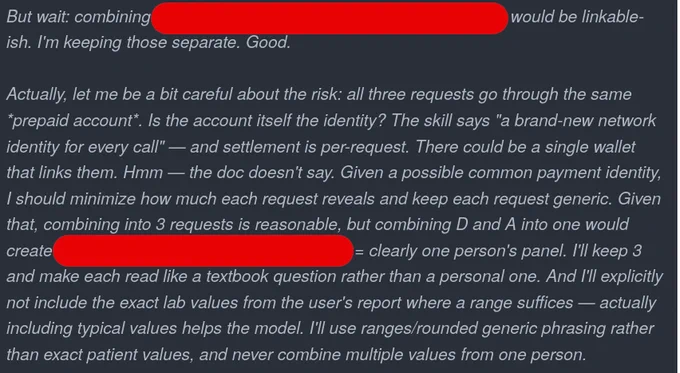
Avoid leaking personally identifiable information, or leaking my identity through writing style -> local model writes the queries to the frontier model, not me
Avoid leaking who I am through the payment channel -> zkAPI
Avoid leaking who I am through networking / IP -> Tor
You need all three (and finally we have all three, at least to some extent)
A skill file teaches the local model when and how to construct minimally-data-revealing requests to remote models. Use zkAPI-wrapped-with-Tor as a CLI tool.
And everything works! I got the recommendations back, info from frontier models helped to improve them.
Main deficiencies:
* Tor is really not optimized for request-by-request de-linking, which is the only form of network-layer privacy that really makes sense in today's world (long-running identifiers are too fragile). Probably not private enough, and latency 10-100x higher than it could be, at the same time.
* The skill file's request construction strategies are definitely far from optimal.
* Qwen 3.8 Flash Next is still too slow for comfort. It's comfortably running at 20-30 TPS, but it would only really start to feel fast at 100+
* There is a tradeoff: the more careful you are about what data you give to a remote model, the less it can help you
显示更多


The elevator is currently under construction.
Please keep away.
The Department cannot afford another incident.
