与「localmodel」相关的搜索结果
localmodel 贴吧
一个关键词就是一个贴吧,路径全站唯一。
用户
未找到
包含 localmodel 的内容


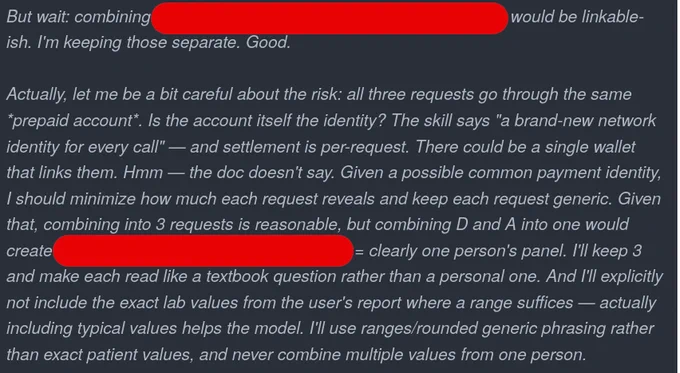
Doing a bit of a self-experiment.
Goal: use my personal health and travel data to provide personalized diet and exercise recommendations for me, using frontier models but in a way that avoids leaking to them any private information.
Strategy: use a local model (Qwen 3.8 Flash Next) to orchestrate, and use powerful remote models as a tool call to benefit from higher-level thinking and knowledge that the local model does not have.
Three-layer approach to privacy:
Avoid leaking personally identifiable information, or leaking my identity through writing style -> local model writes the queries to the frontier model, not me
Avoid leaking who I am through the payment channel -> zkAPI
Avoid leaking who I am through networking / IP -> Tor
You need all three (and finally we have all three, at least to some extent)
A skill file teaches the local model when and how to construct minimally-data-revealing requests to remote models. Use zkAPI-wrapped-with-Tor as a CLI tool.
And everything works! I got the recommendations back, info from frontier models helped to improve them.
Main deficiencies:
* Tor is really not optimized for request-by-request de-linking, which is the only form of network-layer privacy that really makes sense in today's world (long-running identifiers are too fragile). Probably not private enough, and latency 10-100x higher than it could be, at the same time.
* The skill file's request construction strategies are definitely far from optimal.
* Qwen 3.8 Flash Next is still too slow for comfort. It's comfortably running at 20-30 TPS, but it would only really start to feel fast at 100+
* There is a tradeoff: the more careful you are about what data you give to a remote model, the less it can help you
显示更多


Dot, Muse, Grok Bot, and Hermes are all EXCELLENT agents
They all have their own strengths and weaknesses, so you need to know which to use for each task
Here is each agent, and when you should be using them:
GROK BOT- best agent for heavy knowledge work
Strengths: Because you can create many different agents with many different contexts, skills, and memories, you are able to get a wide plethora of work done really really well
Weaknesses: Grok 4.7 is a great model, but not frontier. Also not much usage on cheaper plans.
Who it's for: People who have a diverse set of responsibilities and tasks they need to get done
META MUSE: best agent for getting personal tasks done online
Strengths: Lightning fast, free, and by far the best agent at navigating the internet. Can just 'figure it out' for getting tasks done in browsers
Weaknesses: Not great at coding. Model is lightning quick, but not the smartest or most creative. Weaker at knowledge work because of this.
Who it's for: The best 'personal assistant' agent. Booking reservations, finding flights, filling out forms, unsubscribing from websites. The more 'normie' type use cases. Also it's free. So anyone on a budget.
HERMES: Open source, fully customizable, do anything assitant
Strengths: Fully open source and customizable. Anything you want to change in the agent, you can just change it. Use any model or subscription. Does almost anything you ask without many guardrails. Also a smaller decentralized team supporting it, so it's always great to support the rebels
Weaknesses: No mobile app. Because it's open source and fully customizable, it's not always the most reliable if you tinker too much
Who it's for: tinkerers who want full control over their agent. Also great for the local model community and people with their own home AI labs. My Hermes maintains all my networks and equipment for me better than any other agent
DOT: Your ultimate AI agent project manager
Strengths: The smartest model in the best harness. You get Astra capabilities with best in class ChatGPT tools like Voice, Spaces, and Codex. Can manage all your Codex threads for you and see your projects to completion. Also has ALL of your ChatGPT memories out of the box, so no onboarding needed
Weaknesses: Feels rushed. Lots of rough edges at the moment. Slowest agent. Has trouble with computer and browser use more than you'd like. Tokens in the Dot chat are free, but can heavily burn tokens when managing Codex threads.
Who it's for: Builders who do a lot of coding. ChatGPT power users. Anyone who has long running tasks they'd like an agent to project manage for you
If you put the right agents on the right tasks, you'll have super powers. I use all 4 of these every single day, and switching between them is a breeze
They're all also EXCELLENT agents, so if you can only use one, using any of them is good enough. You can choose literally any of these 4 as daily drivers and you'll be way more productive than the average person
Just make sure you're USING them, and not just reading about them.
显示更多

PRO TIP: If you’re not using Grok @bot you’re missing out. It has replaced OpenClaw, Hermes, & my local model ($10K Mac Minis). Get a Comet Pro Remote KVM to let the bot access your Mac environment. I’m going to sell my Minis (for more than I paid) next week.
显示更多


It’s happening
Default will be local model by next year for most corporate workers
it's one click in buzz to make a local model available to agents AND share your compute with other people.
just one.
and your agents will automatically chose the largest/best shared model available.
显示更多


⚪️ New App: Slate — a voice journal built on one rule: nothing leaves your phone.
100% Apple, top to bottom. Transcription by SpeechAnalyzer on device. Reflection by the 3 billion parameter Apple Intelligence model on the Neural Engine. Storage in SwiftData. Swift 6, SwiftUI, Liquid Glass. Zero third-party code in the binary.
There's no account. No analytics. No tracking. No third party SDKs. No network calls. The app is private because there is nothing to collect. Turn on airplane mode and everything still works. There's no server.
You speak your mind and slate writes it down. It notices patterns and reads your week back to you in a summary every Sunday.
The local model is an observer. It never replies or advises or comforts. When it has nothing real to say, it says nothing.
显示更多


QVAC SDK 0.14.0 is live.
This release makes the on-device stack faster on mobile, ships the developer-agent path, and takes local text-to-speech to 31 languages.
Main highlights:
- OpenCode and OpenClaw. The first official OpenCode plugin, plus a maintained OpenClaw compatibility path, both built on managed mode and qvac serve. Point a coding agent at a local model with far less setup and far fewer surprises.
- Brain-computer interface transcription, on the SDK. Take recorded neural signal data and decode it into text, fully on-device, no cloud. Stream it in chunks through a simple API. In 0.14 it runs GPU-accelerated on iOS.
- Text to Speech in 31 languages with our Supertonic3 upgrade.
VOICE AND SPEECH
- Supertonic3 multilingual TTS, 5 languages to 31.
- Chatterbox and Supertonic now run on the Android GPU, with lower memory use (especially on iOS), quantized s3gen Chatterbox support, and a fix for Chatterbox occasionally emitting random speech.
- Whisper transcription now runs on the iOS GPU. Parakeet runs on the Android GPU, with steadier real-time streaming.
VISION AND OCR
- VLM multi-tile batching: high-resolution Pan and Scan images are encoded in one pass instead of tile by tile, for faster vision throughput.
- OCR on ggml (EasyOCR and DocTR) reaches full speed parity with the onnx path, across Metal, OpenCL, and Vulkan.
PLATFORM AND RELIABILITY
- Dynamic compute backends on Linux: one build picks the right backend at runtime, and opens the door to ROCm and CUDA support without per-backend builds.
- Thinking tokens are kept out of the model context, so reasoning no longer fills the KV cache.
SDK 0.14.0 is now leaner and faster to start.
Let’s build.
显示更多


In Chinese, “2B” has long been used as an insult.
Turns out it was way ahead of its time.
It basically means someone performs worse than a 2B local model.

What should I buy if the budget is $5k? Macmini, 3090?? Needs to run Hermes for the team and local model like qwen 27b