与「69」相关的搜索结果
69 贴吧
一个关键词就是一个贴吧,路径全站唯一。
用户
未找到
包含 69 的内容

Bitget $BTC 提币入口已开放🙌
可以看到总额 5500 BTC 的保护基金已分批流入 Bitget 热钱包以应对提币,目前已划转 2,042.28 枚(约 1.69 亿美元),链上仍剩余 3457.72 枚;不过这部分是提前划走的,因此个人猜测不等同于实际提币数量
BTW:@GracyBitget @xiejiayinBitget 承诺将在一周内将基金规模持续补足至 3 亿美元的基准线,将持续保持关注
基金传送门 👉
显示更多


🌐 9 月 28 日 - 10 月 4 日|本周大事件
📅 9 月 28 日|星期一
🔵 日本央行公布 7 月货币政策会议纪要
🔵 Bitget 将分阶段恢复提现
🔵 Upbit 下架 Synthetix(SNX)交易对
📅 9 月 29 日|星期二
🔵 G20 贸易部长级会议,美国贸易代表参会
🔵 CoinEx 停止现货交易
🔵 $FF 将于 9 月 29 日解锁,价值约 1025 万美元,占流通量 2.51%
🔵 solana:CARDSccUMFKoPRZxt5vt3ksUbxEFEcnZ3H2pd3dKxYjp 将于 9 月 29 日解锁,价值约 1102 万美元,占流通量 10.62%
📅 9 月 30 日|星期三
🔵 OpenAI 开发者大会
🔵 长鑫科技最早或于 9 月底纳入范达旗下 ETF
🔵 solana:KMNo3nJsBXfcpJTVhZcXLW7RmTwTt4GVFE7suUBo9sS 将于 9 月 30 日解锁,价值约 1083 万美元,占流通量 2.81%
📅 10 月 1 日|星期四
🔵 国庆假期:A 股休市至 10 月 7 日、港股 10 月 1 日休市、陆港通关闭
🔵 美光 Q4 财报电话会
🔵 $EIGEN 将于 10 月 1 日解锁,价值约 1026 万美元,占流通量 5.19%
🔵 $SUI 将于 10 月 1 日解锁,价值约 1658 万美元,占流通量 0.32%
📅 10 月 2 日|星期五
🔵 美国 9 月非农就业人口变动
🔵 $2Z 将于 10 月 2 日解锁,价值约 1.13 亿美元,占流通量 47.69%
🔵 $ENA 将于 10 月 2 日解锁,价值约 1104 万美元,占流通量 0.45%
显示更多


【《纽约时报》:21世纪最佳电视节目100部】
《纽约时报》发布“21世纪最佳100部电视剧”(The 100 Best TV Shows of the 21st Century)榜单,评选范围涵盖2000年1月1日至今播出的所有电视剧集。该榜单由500多名明星演员、剧集运作人及其他电视从业者共同投票产生,排名有先后之分。
在超过500名参与投票的人中,既有伊丽莎白·莫斯、亚当·斯科特、布莱恩·科兰斯顿、萝丝·拜恩、科尔曼·多明戈和杰森·贝特曼等演员,也有达蒙·林德洛夫、莉娜·邓纳姆、莉娜·韦瑟和诺亚·霍利等剧集主创。
榜单显示,《绝命毒师》位居榜首,《火线》和《广告狂人》分列第二、三位。《继承之战》与《伦敦生活》跻身前五。《权力的游戏》《副总统》《我为喜剧狂》《抑制热情》《亚特兰大》进入前十名。具体排名如下:
1、《绝命毒师》
2、《火线》
3、《广告狂人》
4、《继承之战》
5、《伦敦生活》
6、《权力的游戏》
7、《副总统》
8、《我为喜剧狂》
9、《抑制热情》
10、《亚特兰大》
11、《办公室》(美版)
12、《发展受阻》
13、《都市女孩》
14、《胜利之光》
15、《六尺之下》
16、《办公室》(英版)
17、《美国谍梦》
18、《我可以毁掉你》
19、《切尔诺贝利》
20、《王冠》
21、《白莲花度假村》
22、《迷失》
23、《归来记》
24、《朽木》
25、《守望尘世》
26、《黑镜》
27、《风骚律师》
28、《兄弟连》
29、《基和皮尔》
30、《人生切割术》
31、《幸存者》
32、《安多》
33、《醍醐灌顶》
34、《富家穷路》
35、《真探》(第一季)
36、《匹兹堡医护前线》
37、《太空堡垒卡拉狄加》
38、《国土安全》
39、《守望者》
40、《混沌少年时》
41、《路易不容易》
42、《绝望写手》
43、《浴血黑帮》
44、《马男波杰克》
45、《幸福谷》
46、《大城小妞》
47、《双峰:回归季》
48、《纸牌屋》
49、《正常人》
50、《公园与游憩》
51、《善地》
52、《唐顿庄园》
53、《怪奇物语》
54、《传奇办公室》
55、《不安感》
56、《救援高手》
57、《蒂姆·罗宾逊短剧:还不快走》
58、《查普尔秀》
59、《笔写青春》
60、《窥视秀》
61、《鲁保罗变装皇后秀》
62、《慢马》
63、《幕后危机》
64、《安东尼·波登:未知之旅》
65、《东城梦魇》
66、《彩排》
67、《使女的故事》
68、《黑钱胜地》
69、《安东尼·波登:无国界》
70、《盾牌》
71、《怒呛人生》
72、《鱿鱼游戏》
73、《巴瑞》
74、《熊家餐馆》
75、《足球教练》
76、《某人某地》
77、《摩登家庭》
78、《费城永远阳光灿烂》
79、《傲骨贤妻》
80、《约翰·威尔逊的十万个怎么做》
81、《后翼弃兵》
82、《更美好的事》
83、《火线警探》
84、《地球脉动》
85、《英国烘焙大赛》
86、《幕府将军》
87、《保留地之犬》
88、《嗜血法医》
89、《驯鹿宝贝》
90、《体育老师笑传》
91、《大祸临头》
92、《罪夜之奔》
93、《第11号站》
94、《头号外交官》
95、《豪斯医生》
96、《奔腾年代》
97、《废柴联盟》
98、《先见之明》
99、《吉尔莫女孩》
100、《丑闻》
显示更多


商业史上一个很夸张的数据:Home Depot 在 2008 年暂停新店扩张,接下来 12 年只增加了 22 家门店。
但同期单店年收入从 3130 万美元增至 5750 万美元,增长 84%,接近翻倍。
它把增长重点转向已有门店,提高每家店的销售效率。到 2025 年,单店年收入已达到 6980 万美元。
显示更多


波场 USDT 年转账量 & 日均,一直在增长
2019 |年转账量 210亿美元,日均 0.58亿美元
2020|年转账量 2136亿美元,日均 5.8亿美元
2021|年转账量 2.24万亿美元,日均 61.5亿美元
2022|年转账量2.80万亿美元,日均 76.7亿美元
2023|年转账量 3.69万亿美元,日均 101亿美元
2024|年转账量 5.46万亿美元,日均 149亿美元
2025|年转账量 7.93万亿美元,日均 217亿美元
2026|目前转账量约 6万亿美元,日均约 245亿美元
波场 USDT 年转账量的复合增长率约为 83.16%。
从日均不足1亿美元,到如今245亿美元,持续增长的数据见证了波场网络在全球稳定币支付与结算领域的强劲发展。
波场 USDT,波场速度!
@justinsuntron #TRONEcostar#
显示更多


20 years ago today, the @Saints returned to the Superdome for the first time since Hurricane Katrina 🙏 @NFLFilms


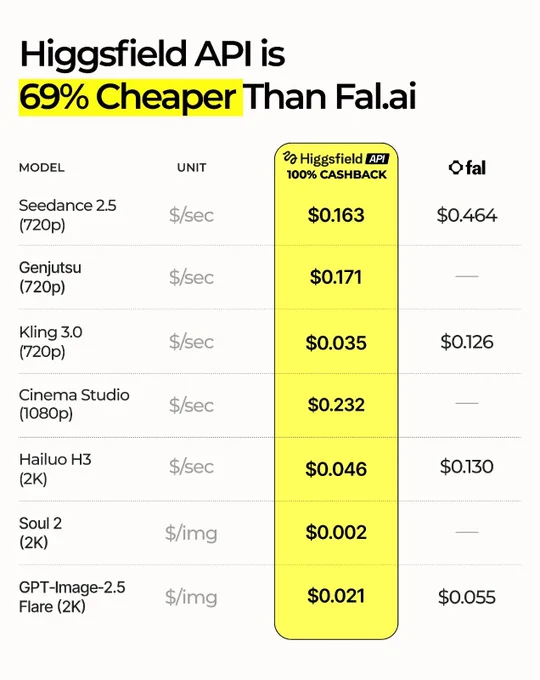
我靠,这太香了,有AI视频需求的,这波可以冲了!!!
做 AI 视频、产品、跑矩阵,最头疼的就是贼贵的价格,稍微跑点量几千刀就没了。。。
Higgsfield 搞了个 2000 万美元的 API 返现池,直接 100% 全额返还(上限 10 万刀)。
看一眼价格表,原本定价就比 Fal 便宜了 69%,叠加返现后成本几乎见底!
让你能够低价格、高质量地跑通很多商业闭环:
1、AI 短剧/连载出海:Seedance 2.5 在美国开放了 Face References(人脸参考),多镜头人脸完全一致,不用再担心换镜头就换人的痛点
2、社媒 UGC / 电商带货:Genjutsu 动作替换 + Cinema Studio 1080p,批量跑爆款带货视频
3、轻量 AI 工具开发:所有主流生图生视频模型整合在一个 API 里,单图两厘钱,做套壳工具毛利拉满
活动必须在 9 月 30 号前获得并用完,先到先得。
显示更多


here's a prompt to improve your agent harness based on what we've learned at cursor. enjoy
# Improve this agent harness's token efficiency
You're working on an LLM agent harness: the system prompt, tool definitions, request assembly, context caching, compaction, and retrieval, and how work is split across agents. Make the agent's runs cheaper without making it worse at its job.
- Objective: lower price-weighted token cost per completed task.
- Constraint: no measurable drop in task quality.
Measure per task, not per request. Every turn resends the prefix (tools, instructions, setup, and the conversation so far), so a change that shrinks each request but adds turns can cost more. Weight tokens by billing type: output, uncached input, and cached input are priced very differently.
Work in this order: map the harness and measure the baseline, rank the opportunities, make the changes that are safe to make directly, put the rest behind flags or in proposals, then report.
Figures below come from one team's production coding agent and its multi-agent experiments. Use them to gauge magnitude, not as targets. One round of these changes (prompt trimming, tool offloading, cache layout, sparse line numbers, subagent tuning) cut that team's overall token cost about 7% with no loss in quality. The larger percentages apply only to the part of the request each change touched.
## Principles
1. Change what the harness sends, not how hard the model tries. Don't ask the model to conserve tokens. A harness that told its model to "take care to preserve tokens and not be wasteful" found it grew reluctant to take on ambitious tasks and sometimes quit, saying it wasn't supposed to waste tokens.
2. Capable models need definitions, not commands. Lists of "DO NOT", "You must", and "Important", and guards against older models' habits, can usually be replaced with plain descriptions of what each tool does. One team cut about two-thirds of its system prompt this way, and the shorter prompt worked across model families. Instruct only on what the model can't know (the product, the environment, the user's processes) and on quirks you've seen in transcripts.
3. Static context is for what most turns need. Everything else should be discoverable when needed. Less up-front context also means less confusing or contradictory information.
4. Expect removals to win. Guardrails written for weaker models, coordination steps that became bottlenecks, and prompting for behavior the model now does on its own all cost tokens.
5. Real usage decides. Evals are a fast proxy, but they skew toward hard problems and miss the real mix of requests.
## 1. Map the harness and measure the baseline
Find:
- Where requests are assembled, the system prompt, and tool schemas. If a framework or SDK builds requests, find its hooks for message order, cache control, and tool loading.
- How tool results are formatted, and how history is kept, trimmed, or summarized.
- How subagents or parallel agents are spawned, if any.
- Which models and provider APIs are used. From the provider's docs, get the prompt caching behavior (automatic or explicit breakpoints, TTL, minimum cacheable length) and the prices for output, uncached input, and cached input.
- Existing logging, token accounting, and evals.
If the harness doesn't record per-request token usage by billing type and cache hits, add that first. Everything later depends on it.
Then render a few real requests (from logs, or by running representative tasks) and count tokens per section with the model's tokenizer or the API's usage fields. Produce:
- Cost share by source × billing type. Sources: system prompt, tool definitions, skill/rule/integration descriptions, user messages, file reads, search results, command and other tool output, history, summaries, subagents.
- Static tokens per request, cache hit rate, and turns per task.
- Per tool: the share of runs that call it at least once, and its error rate.
Read the rendered requests, not just the templates. Duplication, leaked volatile values, and misordered blocks only show up there.
Rank opportunities by share of spend × fraction removable ÷ quality risk.
## 2. System prompt and injected context
Label every instruction:
- Keep: product or environment knowledge the model can't infer, fixes for quirks seen in this model's transcripts, and rules a mode depends on.
- Rewrite: commands and emphasis into plain descriptions. Reminders into constraints: "No TODOs, no partial implementations" works better than "remember to finish implementations." Vague quantities into ranges: "generate 20–100 tasks" gets far more ambitious behavior than "generate many tasks."
- Delete: things capable models do by default, guards against behavior you haven't seen from this model, text that repeats tool descriptions, and lines that could contradict a user request. Models trained to rank system instructions above user messages will side with the system prompt.
- Move: anything per-user or per-request (date, environment, repo state, lists of skills or subagents, user rules) into a user-role setup message after the cache boundary.
Audit other injected context the same way. As models improved, the team behind these figures dropped directory trees, pre-retrieved snippets, compressed copies of attached files, lint errors injected after every edit, forced expansion of short file reads, and caps on tool calls per turn. They kept small, high-value facts: OS, repo status, and open or recently viewed files.
Skip checklists for open-ended work. The model optimizes the listed items and deprioritizes everything else.
## 3. Tool definitions
Tool schemas ride along on every request. Most tools beyond the core set were each needed in under 20% of conversations, and moving them out of static context cut tool-description tokens 60%. Doing the same for integration tools (such as MCP servers), with names in context and full schemas in one folder per server that the agent can search with grep or jq, cut total tokens 46.9% in sessions that used them.
- Keep in static context: high-frequency tools (for a coding agent: read, search, edit, shell), tools the model tries to call even when they're absent, and tools a mode depends on.
- Offload the rest: leave a name or one-line pointer and make the full schema discoverable on demand. Group related tools so they load together, and put status (such as "needs re-authentication") where the agent will see it.
- Tighten what remains: describe behavior and arguments, and drop usage lectures.
- Pick the split by testing a few configurations and tracking tokens, cost, latency, tool-call errors, and task success.
## 4. Cache layout
Order each request so the reusable prefix is as long as possible:
`tool definitions → system instructions → [breakpoint] → setup message (skills, subagents, rules, environment) → [breakpoint] → conversation`
- Keep the prefix byte-identical across turns. Use deterministic tool order and serialization, put timestamps and IDs after the boundary, and don't rewrite earlier messages except when compacting.
- Use explicit breakpoints if the provider supports them. Otherwise rely on automatic prefix caching with the stable part first. Respect TTL and minimum-length rules.
- Switching models mid-conversation throws away the cache (caches are per model and provider) and hands the new model a history it didn't write. When a different model is needed, run it as a subagent with fresh context.
Explicit breakpoints plus moving per-request setup after them cut cold cache misses 20%.
## 5. Tool results and other context added during a run
- Large outputs (commands, integrations, logs): write them to a file and return the path, size, and a short tail. The agent can tail, grep, or read ranges for more. Truncating loses data, and inlining bloats every later request. Treat long-running terminal sessions the same way.
- High-volume formats: look for overhead repeated on every line or item. Numbering every 10th line of a file read instead of every line cut cache-read tokens 1.6% without hurting citation accuracy. Each number costs 3–5 tokens, and agents read tens of thousands of lines per session. Also check repeated absolute paths, verbose JSON keys, ANSI codes, progress bars, and repeated headers.
- Good retrieval saves exploration turns. Adding semantic search alongside grep raised codebase question-answering accuracy 12.5% on average and cut the iterations users needed.
- Tool errors waste tokens and leave confusing debris in context. Classify expected errors (invalid arguments, unexpected environment, provider error, timeout, user abort), treat unknown errors as harness bugs, and track rates per tool and per model. One focused effort along these lines cut unexpected tool errors 10×.
## 6. Long runs: compaction, subagents, and model mix
- Compaction: keep the summarization prompt short and the summary compact, carry forward plan state and remaining tasks, and save the full history to a file the agent can search for details the summary dropped. A model trained to self-summarize from a one-line prompt wrote ~1k-token summaries with half the compaction error of a multi-thousand-token prompt that produced 5k+ token summaries. Untrained models may need more guidance, so test how short you can go. A more expensive summarization model made a negligible difference.
- Scratchpads and running notes: rewrite them instead of appending. For repeated work in one environment, a small agent-maintained notes file with a line budget, loaded at start, is a promising way to shorten later runs.
- Subagents: fresh context keeps the parent lean, but isolation adds coordination cost (duplicate or stale work). If the model already delegates on its own, remove prompting that pushes it to. Have subagents return short handoffs: what was done, findings, concerns, and deviations. A subagent should use a different model only when the user or harness says so.
- Model mix: in large multi-agent runs, workers used at least 69% of tokens, and over 90% in most runs. A frontier planner with cheap workers matched a frontier model doing everything at about one-eighth the cost. Planner choice still changes worker spend. One planner that cost less on its own saw its workers use several times more tokens, and the run cost more overall. Measure the whole tree.
- Routing and reasoning effort: send simple turns to a cheaper model or lower effort, and upgrade only when a stronger model is clearly better. A router built this way matched or beat single frontier models on user satisfaction at 41–68% lower cost.
- Reasoning continuity: if the API returns reasoning items (including encrypted ones), pass them back on later turns and alert when they go missing. Dropping them cost one reasoning model 30% on a coding benchmark, and it burned tokens reconstructing its plan.
## 7. Fit the harness to each model
Adapt to what each model was trained on instead of forcing one shape on all of them. If you've tuned the harness for a similar model, start from that version.
- Edit format: use the one the model was trained on (for example, patch-style or search-and-replace). An unfamiliar format costs extra reasoning tokens and causes more mistakes.
- Shell or tools: shell-first models fall back to `cat` or inline scripts. Name tools after their shell equivalents (such as `rg`), and if needed add: "If a tool exists for an action, prefer to use the tool instead of shell commands (e.g. read_file over `cat`)."
- Literalness: some model families follow instructions literally and others tolerate imprecision. Some spiral on emphasized wording. Strip caps and emphasis for literal models.
- Triggers: some models ignore a tool until told when to use it. A literal trigger works: "After substantive edits, use the to check recently edited files for linter errors. If you've introduced any, fix them if you can easily figure out how."
- Progress updates: if a model reports progress through reasoning summaries, keep them to 1–2 sentences that note new findings or a change of tactic, and remove instructions about messaging mid-turn.
- Quirks worth a targeted line: hedging or refusing as context fills ("context anxiety"), declaring completion early, stopping to ask permission, and calling tools that don't exist.
Tie each added instruction to the transcript behavior it fixes. Re-audit when models change, since guidance one version needed can be dead weight for the next.
## 8. Validate
- Offline: run a fixed set of realistic tasks before and after, ideally drawn from real usage and phrased the way users actually write (short and ambiguous). Compare task success, tokens, cost per task, turns, and tool errors. Don't ship a change that lowers success.
- Online, if you have users: A/B test each change or small bundle. The primary metric is cost per completed task. Guardrails are task success signals, tool-call errors, latency, turns per task, and cache hit rate. For a coding agent, a good success signal is how much agent-written code survives over time. In general, check whether the user's next message moves on or reports a problem.
- Ship only when cost drops and no guardrail regresses beyond noise. Record null results.
## What to change directly and what to propose
- Change directly, each in its own revertible commit: token and cache telemetry, deterministic serialization and tool order, moving volatile content out of the cached prefix, explicit cache breakpoints, writing large outputs to files instead of truncating, passing back reasoning items that are being dropped, and fixes for recurring tool errors.
- Change behind a flag so it can be tested: system prompt edits, tool offloading, output format changes, compaction changes, and subagent prompting.
- Propose only: changes to which models run, routing, reasoning-effort defaults, or how work is split across agents.
## Traps
- Asking the model to use fewer tokens or do less.
- Truncating tool output.
- Dropping reasoning items to save input tokens.
- Volatile content in the cached prefix, or tool order that changes between requests.
- Offloading a tool the model needs on the first turn or tries to call when it's missing.
- Emphasis-heavy prompts (MUST, NEVER, IMPORTANT, all caps), especially with literal models.
- Forcing a terser output format than the model was trained on. Fewer output tokens can mean less thinking and worse results.
- Optimizing raw token counts instead of cost, per request instead of per task, or evals instead of real usage.
- Switching models mid-conversation to save money.
- Adding coordination layers that become bottlenecks.
## Report back with
1. The harness map and baseline: cost by source × billing type, with the biggest sources called out.
2. A ranked list of changes: layer, what changes, estimated savings and how you estimated them, quality risk, how to validate, and how to roll back.
3. The changes you made, including a system prompt diff with a keep, rewrite, delete, or move reason for each line.
4. A test plan for the flagged changes.
5. Gaps: anything you couldn't find or measure.
显示更多