与「Clinical」相关的搜索结果
Clinical 贴吧
一个关键词就是一个贴吧,路径全站唯一。
用户
未找到
包含 Clinical 的内容

AI Drug Discovery Is Becoming a Bottleneck Trade
I get excited when an industry starts going through a real regime change. AI drug discovery (“AIDD”) increasingly looks like one of those moments.
Two things are happening:
1/ Upstream: the frontier AI labs are piling in.
2/ Downstream: The supply chain is clearly moving.
Supply-chain checks suggest the upstream picks-and-shovels of discovery and early preclinical R&D are starting to feel the increase in experimental volume.
DNA → protein → assays → sequencing → automation → preclinical testing
Names across that stack include $TWST , @GenScript , $ILMN , $TXG , lab-automation vendors and CROs.
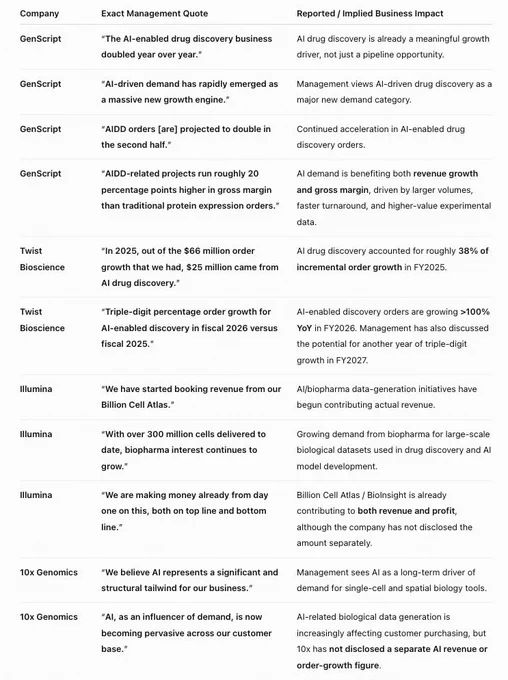
$TWST expects triple-digit percentage growth in AI-enabled drug-discovery orders in FY26, and another year of triple-digit order growth in FY27.
@GenScript's AIDD business doubled YoY in 1H26. Its current platform advertises industrial-scale validation of 4,000+ designs/day, with integrated sequence-to-data workflows. Our channel checks suggest the ramp is moving even faster: roughly 8,000 designs/day currently, with a path toward ~16,000/day by YE26.
---
Why does AI drive more wet-lab demand?
1/ AI makes hypothesis generation almost free → way more shots on goal.
The bottleneck is moving from expert-driven design to biological validation.
2/ AI models need continuous experimental feedback — and both good and bad data are useful.
Traditionally, only the highest-conviction A+ candidates might get pushed into expensive validation. With AI, even the B/C candidates can be valuable because failed experiments generate training data.
@GenScript has said its sequence-to-binding workflow can return data in 4–7 days, and that faster cycle times matter because AI models depend on continuous experimental feedback.
@Anthropic is a clean example. @claudeai designed 1,320 protein binders. @adaptyvbio converted those digital sequences into DNA, expressed the proteins and tested binding. Only 354 actually bound. And the 966 failures are not wasted. They are useful negative labels: what does not express, what does not bind, what has poor affinity. Those results help train the next model iteration.
3/ Wet labs are no longer just making drugs. They are making training data.
$TWST / @GenScript increasingly look like biological data foundries.
$TWST explicitly talks about generating model-ready data from AI-designed sequences. In some workflows, the customer may care less about receiving the physical protein than about getting structured experimental results back into the model.
Traditional drug discovery asks: “Does candidate X work?”
AI drug discovery also asks: “What can this experiment teach the model?”
---
TAM of AIDD
If AI is simply a better R&D tool, the relevant spending pool is the $300–400B of annual global pharma R&D. If AI meaningfully increases the number of viable drug programs, the opportunity is larger because it expands downstream demand for DNA synthesis, protein production, assays, and preclinical work.
Near term, we can also size demand from AI-company spending. If Anthropic reaches $80B of ARR in 2026 and spends just 1% on AIDD, that alone would imply ~$800M of annual investment.
---
Trade setup
This is a trade that could have long legs. It’s hard to really stop working until PhaseI/II results (2028+)
It smells a lot like the bottleneck trade we just saw in semis: GPUs → HBM → networking → power/cooling. In biology, It basically follows the drug discovery process downstream: AI models → designs → DNA/protein → assays → preclinical capacity.
After the upstream picks-and-shovels, animal testing could become the next bottleneck. Monkey prices are already near prior highs and CRO capacity is tight. AIDD pushing more candidates into preclinical development would only add demand.
?? But clinical trials are still the bottleneck?
This is the biggest pushback I keep coming back to. No matter how fast discovery becomes, drugs still need to go through preclinical → Phase I → Phase II → Phase III → approval. You still need patients, time and capital.
But that doesn’t mean the bottleneck trade won’t work. More viable candidates — especially with higher success rates — still means more demand throughout the development process.
And who knows: clinical trials themselves may eventually be optimized by AI.
?? What breaks the trade?
Near term, the picks-and-shovels trade breaks if experimental budgets stop growing, AI-generated designs don’t translate into useful wet-lab hits, or capacity catches up too quickly.
Longer term, the thesis breaks if AI drugs look great in discovery / Phase I but fail at normal rates in Phase II/III. That is why Phase II matters so much.
?? Milestones
Late 2026–2027: first Isomorphic-designed drugs enter human trials; more AI-native programs move into IND-enabling work / tox.
2028–2030: clinical trial results start telling us whether AI-designed drugs actually perform better than conventional drugs.
Calling all the "bottleneck bros". :) @jukan05 @zephyr_z9 @aleabitoreddit @ParadisLabs
+++
More comprehensive analysis:
显示更多


What does a seventy-year-old man who has never left his father's tent have in common with the first murder ever committed? In this lecture, Jordan Peterson works through the story of Cain and Abel and arrives somewhere nobody expects: a precise, almost clinical account of how resentment is manufactured, step by step, in an ordinary person who believes he has been treated unfairly. Along the way he explains why Freud and Jung both thought Nietzsche's solution was impossible, why your reputation is a better place to store wealth than your bank account, what you are actually doing when you tell your son it matters how he plays the game, and the one experiment he ran on himself that he says is worth the price of the ticket on its own. Then Konstantin Kisin comes out to argue that none of it requires God at all, and the conversation turns to the pill, the family, and a question about what has to change in a culture before a technology becomes thinkable. The story of Cain and Abel turns out to be less about an ancient crime than about a door you have already been offered, and whether you opened it.
This lecture was filmed on April 9, 2024, in New York City, New York.
显示更多


Rough back of the envelope math: if 40% of US physicians are OpenEvidence DAUs and there's ~22 workdays a month, 42m queries in August implies ~5 queries per workday day per physician (Google is ~4.2 searches per day and ChatGPT is ~2.5 queries per day).
This kind of pulse on real-time clinical uncertainty is remarkable. Imagine you could now categorize those queries: see for which flavors of clinical uncertainty existing knowledge / solutions are most scant (or don't exist at all) and then plug in that knowledge / those solutions, fund studies / initiatives to create that knowledge / those solutions, etc. You see how OpenEvidence's flywheel will start to spin a lot faster than the labs in terms of capabilities.
It's all about your product enumerating demand in some valuable subset of economic reality faster than competitors. In this case, OpenEvidence enumerates physician demand for information / capabilities that can help solve patient problems. They do this faster and with higher fidelity than anyone else. This is incredibly valuable.
显示更多


My dear friends, I am happy to report the publication of the most important paper in my life to date (we have several great papers coming out but this is very special). Tomorrow, I will present this paper for the first time at the Nature AI Healthcare in Paris and will post a longer post on this story and its broader implications for how to conduct clinical trials. Please read it and comment on it.
Many thanks to the great co-authors of the study and everyone who contributed. Many thanks to the many reviewers (friendly and unfriendly) for spending so much time and helping make it better.
Link in the comments.
显示更多


Grok 4.6 just took the #1# spot on MedAgentBench....one of the most interesting benchmarks for real-world agentic healthcare tasks
and Grok now has two generations sitting in the top 3
• #1# Grok 4.6 — ~95.9%
• #2# GPT-5.6 Sol — ~94.7%
• #3# Grok 4.5 — ~93.4%
MedAgentBench goes far beyond answering medical questions
It tests AI agents on 300 clinically derived tasks across 10 categories inside a realistic electronic health-record environment, requiring the model to reason, use tools and actually execute multi-step clinical workflows
Grok 4.5 was already one of the strongest medical agents tested. Grok 4.6 just pushed it to another level
Grok is rapidly becoming one of the strongest AI model families for agentic healthcare work
显示更多


🥇 We evaluated Grok 4.6 on MedAgentBench, a benchmark for agentic clinical EHR tasks, and it took the top spot. Grok 4.6 posts the highest pass@1 we've measured to date, moving ahead of the previous leader, GPT-5.6 Sol, to claim first place on the leaderboard. 🏥
Grok 4.6 averages ~95.9% pass@1 (avg of 3 runs), edging out the prior best (GPT-5.6-sol at ~94.7%) and improving on Grok 4.5 by roughly 2.5 points. On a benchmark where the model acts as an autonomous agent in a simulated EHR, calling FHIR APIs to complete clinical tasks across 10 task types, the result is also remarkably consistent run to run (95.3% to 96.3%).
📊 Leaderboards:
显示更多

Grok 4.6 just broke into the Top 3 on the Artificial Analysis Healthcare & Medical Index
Grok 4.6 (high) scores 50 - just ONE point off the top score of 51
It outperforms GPT-5.6 Sol, Kimi K3 and Gemini 3.7 Flash
This index measures how models actually handle healthcare and medical work:
• Medical and health knowledge
• Clinical reasoning
• Patient documentation
• Non-hallucination
• Agentic workflows
Healthcare is one of the highest-stakes domains you can test an AI on
And Grok is now competing at the very top of it
显示更多


Precipio, Inc. (@PrecipioDx ) (@Nasdaq : $PRPO ) reported revenue of $7.0 million for the second quarter ended June 30, 2026, the highest quarterly revenue in the company’s history and an increase of 22% from $5.7 million in the second quarter of 2025. The specialty cancer diagnostics company validates its technologies clinically in its own laboratory before commercializing them for the global laboratory community.
Precipio, Inc. is a B2i Digital (@b2idigital )Featured Company. See the company’s in-depth profile at:
Both sides of the business contributed, with pathology services and diagnostic products each growing sequentially:
• Revenue surpassed $7 million for the first time in company history, rising from $6.7 million in the first quarter
• Product revenue reached $0.9 million, an increase of 21% over the previous high of $750,000 in the fourth quarter of 2025, and pathology revenue reached $6.1 million
• Adjusted EBITDA, a non-GAAP measure the company reconciles in the release, was positive at $0.4 million for the quarter
• Cash flow from operations was $0.7 million, and cash ended the quarter above $3 million against $1.1 million a year earlier
• Management will discuss the quarter on a shareholder call on August 17, 2026 at 5 p.m. ET, followed by a moderated question and answer session
The conference call may be accessed by calling 646.307.1865. All callers should ask for the Precipio Inc. conference call.
Regarding the cash balance, Ilan Danieli, Chief Executive Officer of Precipio, stated: “We’ve achieved this level of cash without a financing event, demonstrating the strength of our operations. We’re encouraged by the progress we’ve made and believe we are well positioned to continue building on this momentum.”
Read the full release:
Precipio is a healthcare biotechnology company focused on cancer diagnostics. Its mission is to address the pervasive problem of cancer misdiagnoses by developing solutions in the form of diagnostic products and services that deliver higher accuracy, improved laboratory workflow, and better patient outcomes, which reduce healthcare expenses. Precipio develops innovative technologies in its laboratory where it designs, tests, validates, and uses these products clinically, then commercializes them as proprietary products that serve the global laboratory community. More information is available at Discover more emerging growth Featured Companies, Featured Experts, and upcoming Featured Conferences at
B2i Digital is not a broker-dealer or investment adviser. This post is informational and not an offer or solicitation regarding any security. See the complete Disclosure at
显示更多


New from @GoogleResearch and @GoogleDeepMind: AMIE can now conduct real-time video consultations. In a randomized study using simulated consultations, it met clinical performance benchmarks, showing AI’s potential to expand telehealth access.
Learn more:
显示更多
