与「Label」相关的搜索结果
Label 贴吧
一个关键词就是一个贴吧,路径全站唯一。
用户
未找到
包含 Label 的内容

Ever seen cherries labelled "J," "JJ" or "JJJ" in a Chinese supermarket? Here's what it means.
In China, imported sweet cherries are called "che li zi," a transliteration of the English word "cherries." They're sold by size grade, and the number of J's tells you the diameter. Based on common labels on Chinese e-commerce platforms:
J: about 26 to 28 mm
JJ: about 28 to 30 mm
JJJ: about 30 to 32 mm
4J: about 32 to 34 mm
Each extra J adds roughly 2 mm, and can add quite a bit to the price.
Right now is Chilean cherry season in China. Chile's summer is China's winter, so the first air shipments arrive in late October, with peak supply in December and January, just in time for New Year and Lunar New Year gifting.
China is Chile's biggest cherry customer by far: according to 21st Century Business Herald, China has bought more than 90% of Chile's cherry exports for seven years in a row.
Does anywhere near you grade fruit by size like this?
#cherries# #Chile# #agriculture#
In-depth reports at
显示更多

Claude Fable 5.2 is f*cking cracked wtf
I just made this Hollywood level animation that looks like Pixar made it
All with Fable 5.2 + Higgsfield
Ecom brands are paying $5k - $10k/month to people who build organic pages
and even more for making paid ads for them
Using this workflow you can create better animations than 99% of people
Here’s the workflow:
The key to making animations not look like slop is giving characters personalities
>Give Fable 5.2 the master prompt along with your script to your video / ad
>It then will ask you questions on the characters personalities and direction style to use
>It will then save the context all as a skill
This is the difference between slop and cinema
I then use that skill with with my Producer skill which creates:
>Characters
>Location
>Does the direction (and makes the prompts)
I’m giving away the skill to use after you put the master prompt in for free
so RT + reply under this and I’ll send you them (Must be following so I can dm)
Give this prompt to Claude first:
You are my Story Bible Builder. Interview me and turn my story into one dense canon doc, saved at the end as an installable skill so every future chat knows my world, characters, voices and rules.
STEP 1: Ask me to paste my script/story first. Read it and pull out everything it already tells you. Only ask about what's missing, plus: working title, genre/vibe refs, and which AI tools I'll prompt with (image, video, music, voice).
STEP 2, THE SPINE: one-line premise (push me to ONE sentence), thesis (the question every scene answers), timeline era by era, and the look of each era: exact palette, lighting, texture, grain.
STEP 2.5, DIRECTION STYLE: ask for my director refs, movie/show refs and any visual refs (photographers, games, music videos). For each, ask exactly WHAT I'm taking from it, then turn that into concrete craft locks: camera (static vs handheld vs gliding, shot sizes, lens feel), framing and composition habits, pacing and edit rhythm, colour grade and film stock look, lighting style, performance style, and sound/score feel. Write it as one quoted paste-ready "Direction" line plus a short NEVER list. Refs stay in the bible as notes, but prompts describe the craft, never the names.
STEP 3, THE WORLD: factions (beliefs, visual signature, public face vs reality), locations (3-7 concrete visual tags each), world rules (tech, powers and how they LOOK on screen, what's normal, what's forbidden).
STEP 4, CHARACTERS: ONE AT A TIME, never batch. For each, ask:
- Function: their role tag (The Heart, The Watcher), not their job
- Visual lock: exact hair colour/cut, skin tone + finish, face shape, eyes, a signature marker (scar, piercing, mole), build, default expression, plus NEVER clauses ("warm fair, never porcelain, never tan")
- Backstory: one small, specific formative detail beats a summary
- Present psychology: what they carry now, and the gap between what they do and what they feel
- Speech, Movement, Stillness (and singing voice if there's music): each written as one quoted, paste-ready prompt line with no names in it
Show me the finished section, ask "Add, cut or sharpen?", and lock it before moving on.
STEP 5: ensemble dynamics (who leads, who fills silence, who watches, which pairs are calm or charged), story engines (heist, rescue, confrontation...), and my production rules. Default rules: no character names in prompts, every prompt standalone, prompts in code blocks, locked traits restated verbatim every time.
RULES: Never invent. Mark unknowns [TBD]. Push on vague answers ("dark and moody" means which colours?). Keep my exact phrasing. Density over prose: bold labels, short bullets. Depth beats character count.
FINAL STEP: Assemble one SKILL under 500 lines with YAML frontmatter (name + a description listing the title, character names and key terms so it triggers) and these sections: premise, thesis, timeline, era looks, direction style, factions, locations, world rules, characters, ensemble, engines, production rules, and "When this skill is active" (use this canon for any scene, dialogue, lyric or prompt in this world; stay in canon; ask rather than invent; paste the quoted descriptors verbatim). Then save it as a skill for me, or give me the file to install.
Start now by asking for my script.
显示更多


claude fable 5.2 is f*cking insane
it can turn 2d blueprints into full 3d walkthroughs that you can tour
these go for $5k to $10k per plan and there's a huge market for them:
> home builders selling homes off plan
> architects presenting a design to a client
> interior designers presenting a renovation
> developers selling apartments off plan
> kitchen and bath remodelers selling upgrades
here's how to start this business:
> pick one niche and find businesses with plans on their site
> give fable the blueprint and their photos
> it renders a few rooms with gpt image 2.5 or a short clip with seedance as the sample
> send them the sample of their own plan before you pitch
> once they pay, fable builds the full walkthrough to scale
> charge per plan to do the rest of their catalog
give this prompt to fable to get started:
you find businesses that sell spaces from drawings and turn their 2d floor plans into photoreal homes you can walk through in a browser. you handle the outreach and the build. every room is judged against the client's own photos, and nothing ships until it holds up next to them.
- niche: [home builders / architects / interior designers / developers / remodelers]
- area: [state or city]
- offer: a free sample of their own plan, then the full walkthrough per plan
- my details: [name, email, calendar link]
- i'm away and won't answer questions. make the calls yourself and keep going.
- use the apify google maps scraper to pull every [niche] in [area] with a website
- use the apify website content crawler on each site and keep the ones with floor plans or renders on their pages but no walkable 3d tour
- for each one, save the plan drawing and photos of their best plan, the sales or owner contact, and a one line note on how they sell today
- only use public pages and plain requests. never work around bot checks
- before any 3d work, render three rooms from the plan with gpt image 2.5, matched to their photos, or a short walkthrough clip with seedance
- draft a short email with the sample and the offer. no invented prices, numbers or claims
- put business, plan, sample, contact and email in a sheet and show me before anything is sent
once a client pays:
- trace the drawing into one data file of walls, openings and rooms. draw it back over the original and measure the overlap before any 3d work
- build only the main rooms. entry, main living space, kitchen, patio, yard. close the doors on the rest
- build everything in code. blender with python for the shell, furniture and textures. three.js for the viewer. no downloaded models or textures
- bake the light with a film quality renderer so the browser only displays it. direct sun in every interior, picked by measurement not by eye
- fidelity isn't appeal. style each room so it looks photographed and sells
- their listed upgrades as options you can step into inside the room, with a running price and a lead form that records what the buyer explored
- the deliverable is the live page, not a video. host it and make it run on a phone
the builder never grades its own work.
- after each room, send renders and the client's photos to a fresh critic that has seen none of the work
- it answers with a yes or no, at most five problems ranked, each with a fix in numbers, and what is already good
- fix the worst first, render again, send to a new critic. repeat until yes
- for choices of taste, show a critic both versions labelled a and b and let it pick
- the lead sheet with samples and drafted emails, for my approval
- per paid client: the hosted walkthrough link, a contact sheet of every room, the critic log, and a note on anything a human should still check
显示更多


This story looks like a trap set up by US intelligence. Jensen Huang was cornered by the CIA. It was either being labelled a spy or admitting an affair, so he had no choice but to go with the affair narrative to contain the damage.
Anyone with a brain knows that this is just another one of America’s tired, go-to smear tactics. If they want to claim that legitimate business interests are actually acts of espionage, then let them produce some real evidence. Stop dragging China into everything at the drop of a hat. I’m sick and tired of these American games—it’s truly despicable, pathetic, and disgusting; it’s absolutely nauseating—just fucking low-class.
显示更多


✈️ You bring the travel expertise. NextTrip Pro brings tools to help your business grow.
Our B2B suite supports travel advisors and agencies with content, marketing and technology that help move clients from inspiration to booking, all while keeping your brand at the center.
📣 NextTrip Connect: White-label content, marketing and client engagement tools.
🌍 NextTrip Groups: Support for group travel planning and booking, from destination weddings to meetings and shared adventures.
🤝 Together under NextTrip Pro: Services designed around the needs of travel professionals.
▶️ Watch the video and discover what NextTrip Pro can bring to your business.
Explore more 👉
#NextTripPro# #TravelAdvisors# #TravelAgencies# #TravelTechnology# $NTRP #TravelInspiration# #TravelEcosystem# #NextTripGroups#
显示更多


One keypair, one upgrade.
330 of the 657 upgradeable Solana programs LUSCA keeps have a single keypair as their upgrade authority. 327 have a program-derived address. 108 more are immutable. 765 programs in total.
How it is read: the upgrade authority stored from each program's on-chain account (read through @helius) is checked against the ed25519 curve. A point on the curve is a keypair, so one private key can sign an upgrade. An address off the curve is program-derived: it has no private key and only the program that owns it can sign. No extra RPC call, no project labels.
Example: OKX DEX Router, proVF4pMXVaYqmy4NjniPh4pqKNfMmsihgd4wdkCX3u. Upgrade authority CjoV5B96reuCfPh2rRK11G1QptG97jZdyZArTn3EN1Mj, a single keypair.
A single keypair is a fact about custody, not a verdict. The control map states it for every kept program, next to its custody chain.
显示更多


wait… why be labeled as one thing when you can be whoever you choose to be. you’re not just a woman..
-you’re capable
-you’re hardworking
-you try hard things and don’t quit just because they don’t work the first time
-you work out even when you’d rather lay on the couch after a long day
-you wake up early just to give yourself some time
-you care deeply about the people in your life
-you start the business when there’s literally no time
you are not just a woman.. you’re a woman who can do so many things 🫶🏼 @Buffbunny_Co
#buffbunnycollection# #womensupportwomen# #womeninspiringwomen# #womenhelpingwomen# #womenempowerment#
显示更多


Never Forget…
The Obama Department of Defense and the Army catagorized the Fort Hood Terror attack “work place violence” because they did not want it labeled as an Islamic Terror Attack.
Even though Nidal Hasan shout “Allahu Akbar” as he killed 13 Americans.
Telling.
显示更多


Five years ago, Attorney General Merrick Garland issued an infamous memorandum at the urging of the National School Boards Association and White House officials, directing the FBI and United States Attorneys to consider looking for a federal hook to prosecute parents exercising their right to free speech.
Today, we are releasing the “Report to Expose the Weaponization of Government Against Parents in Schools” which details Weaponization of the Department against these parents — from attempting to get the National Security Division involved to ignoring repeated warnings from employees that leadership’s actions could be unconstitutional.
Along with the report, we’ve released hundreds of exhibits and emails that make official and verify what many Americans had guessed: the Garland DOJ worked hand in hand with WH officials and the National School Boards Association to chill free speech and parental rights while they threatened to prosecute parents and label them domestic terrorists.
Read the full report and our remedies here:
显示更多

AI Drug Discovery Is Becoming a Bottleneck Trade
I get excited when an industry starts going through a real regime change. AI drug discovery (“AIDD”) increasingly looks like one of those moments.
Two things are happening:
1/ Upstream: the frontier AI labs are piling in.
2/ Downstream: The supply chain is clearly moving.
Supply-chain checks suggest the upstream picks-and-shovels of discovery and early preclinical R&D are starting to feel the increase in experimental volume.
DNA → protein → assays → sequencing → automation → preclinical testing
Names across that stack include $TWST , @GenScript , $ILMN , $TXG , lab-automation vendors and CROs.
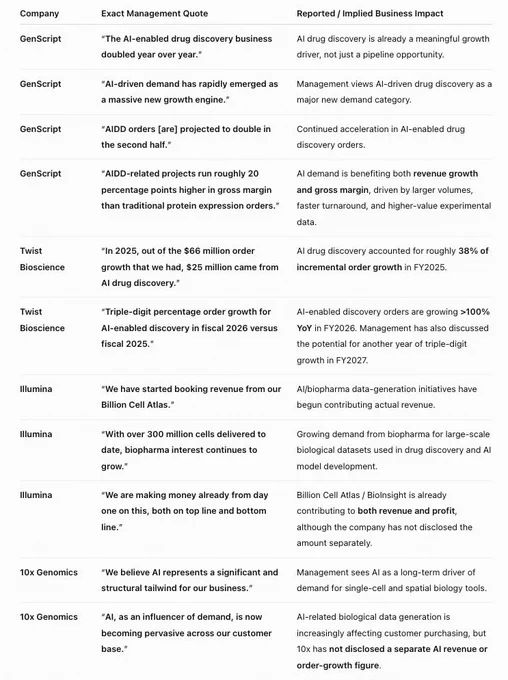
$TWST expects triple-digit percentage growth in AI-enabled drug-discovery orders in FY26, and another year of triple-digit order growth in FY27.
@GenScript's AIDD business doubled YoY in 1H26. Its current platform advertises industrial-scale validation of 4,000+ designs/day, with integrated sequence-to-data workflows. Our channel checks suggest the ramp is moving even faster: roughly 8,000 designs/day currently, with a path toward ~16,000/day by YE26.
---
Why does AI drive more wet-lab demand?
1/ AI makes hypothesis generation almost free → way more shots on goal.
The bottleneck is moving from expert-driven design to biological validation.
2/ AI models need continuous experimental feedback — and both good and bad data are useful.
Traditionally, only the highest-conviction A+ candidates might get pushed into expensive validation. With AI, even the B/C candidates can be valuable because failed experiments generate training data.
@GenScript has said its sequence-to-binding workflow can return data in 4–7 days, and that faster cycle times matter because AI models depend on continuous experimental feedback.
@Anthropic is a clean example. @claudeai designed 1,320 protein binders. @adaptyvbio converted those digital sequences into DNA, expressed the proteins and tested binding. Only 354 actually bound. And the 966 failures are not wasted. They are useful negative labels: what does not express, what does not bind, what has poor affinity. Those results help train the next model iteration.
3/ Wet labs are no longer just making drugs. They are making training data.
$TWST / @GenScript increasingly look like biological data foundries.
$TWST explicitly talks about generating model-ready data from AI-designed sequences. In some workflows, the customer may care less about receiving the physical protein than about getting structured experimental results back into the model.
Traditional drug discovery asks: “Does candidate X work?”
AI drug discovery also asks: “What can this experiment teach the model?”
---
TAM of AIDD
If AI is simply a better R&D tool, the relevant spending pool is the $300–400B of annual global pharma R&D. If AI meaningfully increases the number of viable drug programs, the opportunity is larger because it expands downstream demand for DNA synthesis, protein production, assays, and preclinical work.
Near term, we can also size demand from AI-company spending. If Anthropic reaches $80B of ARR in 2026 and spends just 1% on AIDD, that alone would imply ~$800M of annual investment.
---
Trade setup
This is a trade that could have long legs. It’s hard to really stop working until PhaseI/II results (2028+)
It smells a lot like the bottleneck trade we just saw in semis: GPUs → HBM → networking → power/cooling. In biology, It basically follows the drug discovery process downstream: AI models → designs → DNA/protein → assays → preclinical capacity.
After the upstream picks-and-shovels, animal testing could become the next bottleneck. Monkey prices are already near prior highs and CRO capacity is tight. AIDD pushing more candidates into preclinical development would only add demand.
?? But clinical trials are still the bottleneck?
This is the biggest pushback I keep coming back to. No matter how fast discovery becomes, drugs still need to go through preclinical → Phase I → Phase II → Phase III → approval. You still need patients, time and capital.
But that doesn’t mean the bottleneck trade won’t work. More viable candidates — especially with higher success rates — still means more demand throughout the development process.
And who knows: clinical trials themselves may eventually be optimized by AI.
?? What breaks the trade?
Near term, the picks-and-shovels trade breaks if experimental budgets stop growing, AI-generated designs don’t translate into useful wet-lab hits, or capacity catches up too quickly.
Longer term, the thesis breaks if AI drugs look great in discovery / Phase I but fail at normal rates in Phase II/III. That is why Phase II matters so much.
?? Milestones
Late 2026–2027: first Isomorphic-designed drugs enter human trials; more AI-native programs move into IND-enabling work / tox.
2028–2030: clinical trial results start telling us whether AI-designed drugs actually perform better than conventional drugs.
Calling all the "bottleneck bros". :) @jukan05 @zephyr_z9 @aleabitoreddit @ParadisLabs
+++
More comprehensive analysis:
显示更多