与「WET」相关的搜索结果
WET 贴吧
一个关键词就是一个贴吧,路径全站唯一。
用户
未找到
包含 WET 的内容

code for review :
Prompt :
Create a 2D anime short for the web. It must look completely like real Japanese anime, as if it were taken directly from a finished theatrical anime film. This is traditional-looking, hand-drawn 2D anime, not a 3D animation, a moving illustration, or a stylized web graphic.
Deliver the final result as a single, self-contained HTML file that plays offline, with a synthesized soundtrack. Use any tools, libraries, references, guides, literally anything etc.
Use theatrical mecha and kaiju anime as the art style reference for the design, line work, painted backgrounds, color, and atmosphere. The film is 83 seconds long, in 39 shots. Its characters are a colossal silver archer robot, a fleet of container ships, and a leviathan. No people appear in the film. Use any tools or techniques you want, including 3D, as long as the final result looks 100% like hand-drawn 2D anime.
SCENE
A blazing sunny day on a coast. A massive armored archer robot, a hundred meters tall, stands in a deep lunge on a headland and draws a bow taller than itself. Close-ups: the hand on the grip, the limb and cable, the foot planted in the surf. Blue energy crawls along the arrow into the chest armor until the arrowhead blazes like crystal. The string snaps forward and a shockwave flattens the sea. The arrow is a harpoon trailing a thin cable. It tears the clouds into two walls above a ship's deck, climbs through the cloud tops, and reaches the edge of space in a blue flash along the planet's limb.
Out at sea, container ships cross a colossal shadow. Four humpback whales breach beside a ship, with real arcs and full tail flukes, and dive tail last. From below, shapes move under the bright churning surface. Four whale heads rise from a boiling sea, and a ring of teeth rises around them: they are lures inside a mouth. They drop in and the jaws shut. The leviathan breaches through the fleet in one slow, enormous arc. Its belly slides past the bridge windows. The swell it leaves lifts the ships and stands one on end, spilling containers. Its ridged back and flukes sink into spray fog.
High above, the arrow turns over and comes back red-hot through the atmosphere. Below the surface, the leviathan crawls through a luminous canyon on clawed forelimbs and swallows a fleeing whale. A thin streak meets the sea on the horizon and a white plume swells up. The harpoon drives through its back in a blue-white flash, lightning runs along its body, and the barbed tip punches out of its belly into the rock, which bursts apart. The cable stays attached the whole time, rising to the surface. A mountain of water swells from the sea. The dying leviathan erupts, rolls over between the ships and falls, and a wall of water takes the fleet.
ANIME QUALITY STANDARD
Every frame must look as if it was drawn by professional anime animators and painted by master background artists for a finished theatrical film.
Archer: A massive, heavy anime mecha with sculpted overlapping armor plates, panel lines, bolts, markings and a faceted chest reactor that glows blue. Hands really grip the bow and string. The arrow never passes through the armor. Keep it on-model from every angle.
Leviathan: Whale-like and colossal, always dwarfing the ships. Rough, dark grey-teal wet hide with barnacles and scars, a pale ribbed throat, a spined back, huge clawed flippers, and a cavernous maw with uneven teeth. A real bending body with weight, never a stiff model hanging on pillars of water.
Whales: Real humpback anatomy with tail stock, big notched flukes and long curved flippers rooted in the body.
Ships: Detailed container ships with corrugated multicolor containers, lashing bars and a white bridge tower.
Line art: Confident, delicate, hand-inked anime line work with subtle variation in thickness and pressure.
Coloring: Traditional anime cel coloring with clean color areas, hard-edged cool lavender-blue shadows, crisp highlights, and a bright, high-key, saturated palette. Never gloomy, grey or muddy, even in the darkest moments of the story.
Backgrounds: Richly detailed, hand-painted anime backgrounds in a gouache style: towering white cumulus, a cobalt-to-turquoise sea at kilometer scale, a painted coast with a far town, Earth from orbit, a port city from the stratosphere.
Underwater: Luminous cyan depth with god rays, a rippling surface seen from below, jagged canyon rock, silt and fish. Bright, not black.
Lighting: Summer sun with colorful shadows, and a separate character key light so that nothing sinks into shade.
Effects: Bold drawn anime FX on twos and threes. Sharp lightning with a white core, plasma trails, sheets of water pouring off the body, plumes, spray and a wall of water with real mass. Never particle mush or cotton-wool clouds.
Animation: Authentic hand-drawn anime timing, with characters on twos, strong key poses, natural holds, and overlapping movement. Huge things move slowly and heavily. Nothing clips, slides or floats.
Sound: An original epic score with ominous drones, brass and choir, near silence before the impact, then a colossal hit. Add a recurring whale-song motif, bow creak, charge whine, sonic boom, thunder and the sea, muffled underwater, all timed to the picture.
Direction: Cinematic shots, macro close-ups against huge wide shots, thoughtful staging, and pacing that builds from quiet tension to a devastating climax.
IT MUST NOT LOOK LIKE
- 3D: No plastic materials, CGI shading, visible polygons, game-engine lighting, or computer-perfect perspective.
- Blocky "Minecraft" shapes: No plain boxes, empty flat surfaces, or toy-like proportions. Every surface carries design detail.
- SVG or vector art: No simple geometric shapes, perfect curves, uniform outlines, flat corporate illustration, or basic gradients.
- Web animation: No sliding layers, constant bobbing, floating parts, smooth software easing, or puppet-like joint rotation.
- Pasted-on elements: No 2D sprites floating in a 3D scene.
- AI art: No warped shapes, melted details, flickering, or changing designs.
- Non-anime art: No Western cartoon designs, realistic rendering, soft painterly shading on the characters, or generic digital illustration.
- Amateur work: No stiff poses, empty backgrounds, muddy colors, clip art, placeholders, or unfinished details.
You are free to change any part of the prompt, if it would result in better results.
The result should feel enormous, terrifying and beautiful, a blockbuster in bright anime colors.
Before finishing, inspect random frames as still images. If any frame does not look completely like real 2D anime, keep improving it.
Do not stop until every frame could pass as a still from a theatrical anime film.
显示更多


Almost a decade later, the wet start from Singapore in 2017 is still one of the most dramatic ones we've ever seen 🥴
#F1# #SingaporeGP#


万千绿翅鸭腾空!青海都兰湿地现磅礴“鸟浪”奇观A Grand “Bird Wave”Emerges as Thousands of Green-winged Teals Soar over Dulan Wetland in #Qinghai# Province
显示更多


Presented by @Rolex. A simple branch becomes a fishing rod in the hands of these resourceful chimpanzees. This technique allows them to harvest algae without getting wet.
#AfricaEarthsWildHome# is now streaming on @DisneyPlus and @hulu.
显示更多


PROMPT SHARE: The biggest AI breakthrough isn’t realism. It’s presence.
#AIVideo# #Marketing# #Advertising#
The people, movement, noise and unpredictability give the world a sense of life beyond the camera.
That’s when generation starts becoming experience.
➜ Image Prompt:
Photography & Cinematography
Create an ultra-realistic nighttime street portrait with the raw, spontaneous look of early-2000s nightlife photography. Direct on-camera flash illuminates the subject sharply against a much darker city background, with natural grain, slight highlight blowout, deep shadows, imperfect exposure and authentic point-and-shoot character. No fake or plastic skin, no beauty filtering, no CGI or animated appearance.
Character & Pose
A striking young man with rugged, high-fashion model features, lean athletic build, sharply defined jawline and cheekbones, strong brows, full lips and short dark hair styled wet and tousled with loose curls falling onto his forehead. Natural pores, subtle facial texture and realistic imperfections. He sits casually on the edge of a city curb at night, legs spread asymmetrically, one knee raised toward the camera. One forearm rests loosely across the raised knee while his other hand reaches down beside him toward a small shaggy brown dog partially entering the bottom of the frame. He looks directly into the camera with a serious, confident expression.
Outfit
Fitted black long-sleeve turtleneck, faded distressed gray-blue jeans with worn areas and small rips, and a black leather belt. Silver pendant necklace, small hoop earring, chunky silver cuff bracelet, dark oversized wristwatch, and a thin bracelet. Styling feels slightly rebellious, understated and naturally lived-in rather than polished.
Environment
A busy urban nightlife street after dark. Several casually dressed people walk behind him, cropped naturally by the frame, while parked and passing cars create scattered headlights and small pools of distant light. The pavement is gritty and imperfect with curbs, cracks and ordinary street details visible. Keep the background activity believable and incidental—the image should feel like a real moment caught outside a club or late-night gathering, not a staged fashion shoot. Wide horizontal composition, intimate close-range flash photography, authentic real-world energy.
显示更多


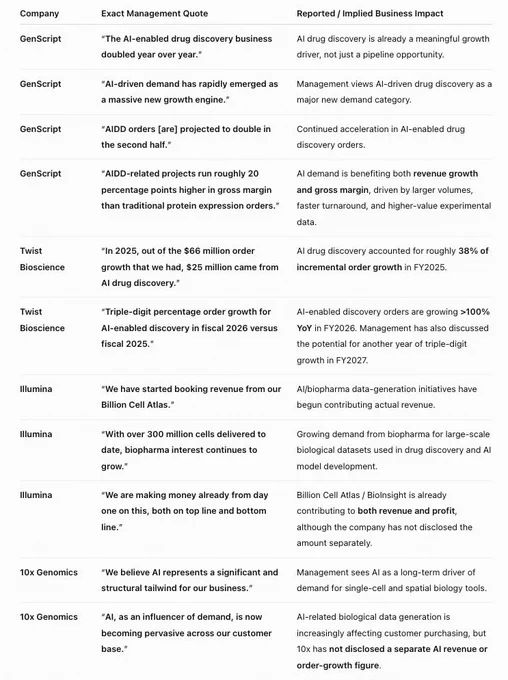
AI Drug Discovery Is Becoming a Bottleneck Trade
I get excited when an industry starts going through a real regime change. AI drug discovery (“AIDD”) increasingly looks like one of those moments.
Two things are happening:
1/ Upstream: the frontier AI labs are piling in.
2/ Downstream: The supply chain is clearly moving.
Supply-chain checks suggest the upstream picks-and-shovels of discovery and early preclinical R&D are starting to feel the increase in experimental volume.
DNA → protein → assays → sequencing → automation → preclinical testing
Names across that stack include $TWST , @GenScript , $ILMN , $TXG , lab-automation vendors and CROs.
$TWST expects triple-digit percentage growth in AI-enabled drug-discovery orders in FY26, and another year of triple-digit order growth in FY27.
@GenScript's AIDD business doubled YoY in 1H26. Its current platform advertises industrial-scale validation of 4,000+ designs/day, with integrated sequence-to-data workflows. Our channel checks suggest the ramp is moving even faster: roughly 8,000 designs/day currently, with a path toward ~16,000/day by YE26.
---
Why does AI drive more wet-lab demand?
1/ AI makes hypothesis generation almost free → way more shots on goal.
The bottleneck is moving from expert-driven design to biological validation.
2/ AI models need continuous experimental feedback — and both good and bad data are useful.
Traditionally, only the highest-conviction A+ candidates might get pushed into expensive validation. With AI, even the B/C candidates can be valuable because failed experiments generate training data.
@GenScript has said its sequence-to-binding workflow can return data in 4–7 days, and that faster cycle times matter because AI models depend on continuous experimental feedback.
@Anthropic is a clean example. @claudeai designed 1,320 protein binders. @adaptyvbio converted those digital sequences into DNA, expressed the proteins and tested binding. Only 354 actually bound. And the 966 failures are not wasted. They are useful negative labels: what does not express, what does not bind, what has poor affinity. Those results help train the next model iteration.
3/ Wet labs are no longer just making drugs. They are making training data.
$TWST / @GenScript increasingly look like biological data foundries.
$TWST explicitly talks about generating model-ready data from AI-designed sequences. In some workflows, the customer may care less about receiving the physical protein than about getting structured experimental results back into the model.
Traditional drug discovery asks: “Does candidate X work?”
AI drug discovery also asks: “What can this experiment teach the model?”
---
TAM of AIDD
If AI is simply a better R&D tool, the relevant spending pool is the $300–400B of annual global pharma R&D. If AI meaningfully increases the number of viable drug programs, the opportunity is larger because it expands downstream demand for DNA synthesis, protein production, assays, and preclinical work.
Near term, we can also size demand from AI-company spending. If Anthropic reaches $80B of ARR in 2026 and spends just 1% on AIDD, that alone would imply ~$800M of annual investment.
---
Trade setup
This is a trade that could have long legs. It’s hard to really stop working until PhaseI/II results (2028+)
It smells a lot like the bottleneck trade we just saw in semis: GPUs → HBM → networking → power/cooling. In biology, It basically follows the drug discovery process downstream: AI models → designs → DNA/protein → assays → preclinical capacity.
After the upstream picks-and-shovels, animal testing could become the next bottleneck. Monkey prices are already near prior highs and CRO capacity is tight. AIDD pushing more candidates into preclinical development would only add demand.
?? But clinical trials are still the bottleneck?
This is the biggest pushback I keep coming back to. No matter how fast discovery becomes, drugs still need to go through preclinical → Phase I → Phase II → Phase III → approval. You still need patients, time and capital.
But that doesn’t mean the bottleneck trade won’t work. More viable candidates — especially with higher success rates — still means more demand throughout the development process.
And who knows: clinical trials themselves may eventually be optimized by AI.
?? What breaks the trade?
Near term, the picks-and-shovels trade breaks if experimental budgets stop growing, AI-generated designs don’t translate into useful wet-lab hits, or capacity catches up too quickly.
Longer term, the thesis breaks if AI drugs look great in discovery / Phase I but fail at normal rates in Phase II/III. That is why Phase II matters so much.
?? Milestones
Late 2026–2027: first Isomorphic-designed drugs enter human trials; more AI-native programs move into IND-enabling work / tox.
2028–2030: clinical trial results start telling us whether AI-designed drugs actually perform better than conventional drugs.
Calling all the "bottleneck bros". :) @jukan05 @zephyr_z9 @aleabitoreddit @ParadisLabs
+++
More comprehensive analysis:
显示更多


I want to make more craft/WIP videos (even though it takes me so long because I'm still new to editing) and I was just really proud how my Nerissa turned out 😭💙
Base cosplay from @wetrose2019
#RavenCrafts# #nerissaravencroft# #hololive# #hololiveen# #cosplay# hololive advent
显示更多


🚨SlowMist TI Alert🚨
💸 @Goldpesatoken Loss: ~$114.9k
🔍 Root Cause: GPXHooks' reBalance() performs liquidity operations through the shared, flash-accounted PositionManager inside an attacker-controlled PoolManager unlock without verifying that the PositionManager's GPX/USDC currency deltas are zero, so the hook's burn credit is not isolated from the caller's state. The attacker opens an unlock, mints a WETH/USDC position via MINT_POSITION without settling (leaving the shared PositionManager with a −114,999.999187 USDC delta), then swaps on the GPX pool to trigger the hourly rebalance: the hook burns its real position and earns a +148,868.602189 USDC credit, but TAKE_PAIR can only withdraw the net positive delta, so the hook receives just 33,868.603002 USDC while the attacker's phantom debt absorbs the difference. Burning its own position cancels that debt and the attacker takes 114,999.999186 USDC straight out of the PoolManager — a missing delta-isolation / zero-delta check on a shared PositionManager.
📌 Attacker: 0x4a5FD2e9357cC87DF4cD6A1808174DBc8646899F
📌 Victim: 0x4519e2b040ff1B64fa03aBe2AeF0BC99D7CcEaA8
📌 Vulnerable Contract: 0x4519e2b040ff1B64fa03aBe2AeF0BC99D7CcEaA8
Powered by
Tx:
显示更多
🚨SlowMist TI Alert🚨
💸 @aave v3 Loop Safe Module Loss: ~114.09 ETH
🔍 Root Cause: FlashLoopAdapter's open()/close() access control only checks ISafe(msg.sender).isModuleEnabled(address(this)), which is spoofable via a fake Safe that always returns true. Its _swap() then executes with fully attacker-controlled router and calldata. Since the adapter is an enabled module of the victim Safes, the attacker set router=victim Safe and data=execTransactionFromModule to drain weETH and Aave collateral.
📌 Attacker: 0x42c2633438609881c8fBAb82414eb9A0c45F9353
📌 Victim: 0xe3b23e47df7cd85876ac6cb05bdb9d7cd5b28520, 0xcfedf95a3653a128dfc2e4288758a1a1850d169f
📌 Vulnerable Contract: 0x16bb8b912da187870c23ec6756bb3fad061283d8
Impact: ~114.09 ETH stolen from two Safe multisigs via forged Safe authentication and arbitrary module execution; ~1300 WETH debt repaid to unlock collateral.
Powered by
Tx:
显示更多