与「convention」相关的搜索结果
convention 贴吧
一个关键词就是一个贴吧,路径全站唯一。
用户
未找到
包含 convention 的内容

GCSA Insight: Critical Security Vulnerability Discovered in a Leading Robotics Manufacturer’s Product, with System-Level Privilege Compromise Verified on Physical Hardware
As artificial intelligence and embodied AI technologies continue to advance, robots are evolving from conventional automated machines into intelligent systems capable of perception, decision-making, and autonomous operation. At the same time, cybersecurity risks are extending beyond software and data into the physical world. The security of robotic systems is no longer solely a matter of protecting data and devices; it can also directly affect operational safety, physical environments, and user safety.
Recently, the security research team of the Global Cybersecurity Alliance (GCSA) discovered and verified a critical security vulnerability in a product developed by a leading robotics manufacturer. Through in-depth analysis and multiple rounds of testing on physical hardware, the team successfully breached the device’s system security boundaries and obtained the highest level of operating system privileges in a real-world device environment, demonstrating the vulnerability’s actual impact under specific testing conditions.
This research encompassed the entire process, from identifying the security flaw and assessing its risks to validating its impact on physical hardware. The findings also highlight significant challenges facing the underlying security mechanisms of embodied AI systems. The research findings and supporting evidence have been formally submitted to the manufacturer.
On November 13, 2026, the manufacturer responded by email, preliminarily confirming the existence of the vulnerability and stating that it had initiated internal remediation efforts and an assessment of the scope of affected products.
It is important to emphasize that confirmation of a vulnerability does not mean the associated security risks have been eliminated. GCSA will continue to monitor the manufacturer’s assessment of the affected scope, remediation plans, and subsequent security validation, and will update its research findings as new information becomes available. For intelligent systems capable of physical interaction and movement, timely, effective, and verifiable security remediation is particularly important.
In accordance with responsible vulnerability disclosure principles, GCSA is currently withholding sensitive information, including the manufacturer’s identity, specific product details, the vulnerability’s underlying mechanisms, and exploitation methods.
GCSA is currently seeking guidance from relevant authorities and regulatory bodies regarding the associated security risks. Taking into account the manufacturer’s remediation progress and a comprehensive assessment of potential security implications, GCSA will carefully determine the appropriate arrangements for further disclosure. Subject to appropriate conditions and upon obtaining the consent of the relevant authorities and regulatory bodies, GCSA will publicly release a detailed security insight report, providing the industry with ongoing updates on the research findings and associated risk assessments.
The findings of this research are based on specific testing environments and the evidence obtained to date. They do not imply that other product models or similar robotic systems are affected by the same security issue.
This security research and validation on physical hardware represent one of GCSA’s initiatives in the field of embodied AI security. GCSA will continue to advance security research, coordinated vulnerability disclosure, and industry collaboration to promote stronger security response mechanisms across the artificial intelligence sector, enhance product security, and strengthen industry trust.
🔗 Read the full report:
· Stay Connected with GCSA
Follow GCSA's official social media channels for the latest news, product launches, research developments, and ecosystem updates.
GCSA Official Telegram Channel:
GCSA Official WeChat Account:
#GCSAInsight# #GCSACybersecurity# #GCSASecVibe#
显示更多


JUST IN: @trondao, @Tether and @Chainalysis launch the Digital Crime Task Force, targeting illicit $USDT activity on Tron as AI-enabled scams prove 4.5x more profitable than conventional schemes, with Tether having already frozen $7B+ linked to illicit activity.
显示更多


《新加坡Token2049 跑会攻略》
作为TOKEN2049冠名赞助商
OKX 真是太有排面了!🤩
主舞台有Star、前纽约州州长
还有 F1迈凯伦的赛车手兰多
现场还有免费的咖啡点心
怎么找到这些地方?
首先,地铁坐到 Bayfront 站
从 E 出口前往金沙会展中心
打车就直接搜 Sands Expo and Convention Centre
进入会场,直上五楼!
听分享,认准 OKX MAIN STAGE,
也就是我们的主舞台
想逛展、领周边,就找 PB5-70 的 OKX 展位,在连接四楼的扶梯口附近。
今天主舞台这两场对话
也一定要留好时间!
中午十二点半到十二点五十,我们的 Star 会和前纽约州州长、OKX 董事会董事 Andrew Cuomo 同台,聊聊 AI 和加密将如何塑造下一代金融市场。
什么?来现场,你还想追星?
没错!迈凯伦车手兰多·诺里斯,会和我们的管理合伙人兼 CMO Haider 同台对话,聊聊「极速制胜」!
平时在屏幕里看他跑赛道,今天就来现场听兰多聊聊赛车和 Web3!下午三点半记得提前到场,三点三十五到四点,一起看这场对话!
听完别急着走,还有礼物等着你!
这次我们准备了上万份周边,小挎包、手机挂绳、OKX 扇子,还有醒目的绿色袋子,打卡发推答题就能领取!
在现场碰到我,也可以找我领周边哦!
显示更多




AI Drug Discovery Is Becoming a Bottleneck Trade
I get excited when an industry starts going through a real regime change. AI drug discovery (“AIDD”) increasingly looks like one of those moments.
Two things are happening:
1/ Upstream: the frontier AI labs are piling in.
2/ Downstream: The supply chain is clearly moving.
Supply-chain checks suggest the upstream picks-and-shovels of discovery and early preclinical R&D are starting to feel the increase in experimental volume.
DNA → protein → assays → sequencing → automation → preclinical testing
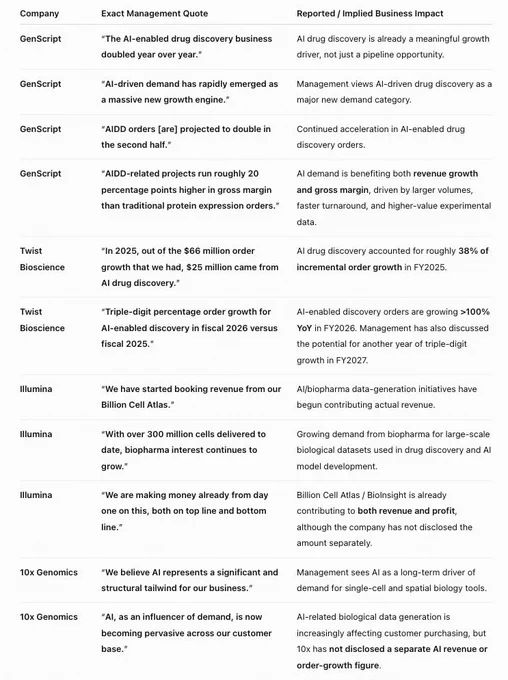
Names across that stack include $TWST , @GenScript , $ILMN , $TXG , lab-automation vendors and CROs.
$TWST expects triple-digit percentage growth in AI-enabled drug-discovery orders in FY26, and another year of triple-digit order growth in FY27.
@GenScript's AIDD business doubled YoY in 1H26. Its current platform advertises industrial-scale validation of 4,000+ designs/day, with integrated sequence-to-data workflows. Our channel checks suggest the ramp is moving even faster: roughly 8,000 designs/day currently, with a path toward ~16,000/day by YE26.
---
Why does AI drive more wet-lab demand?
1/ AI makes hypothesis generation almost free → way more shots on goal.
The bottleneck is moving from expert-driven design to biological validation.
2/ AI models need continuous experimental feedback — and both good and bad data are useful.
Traditionally, only the highest-conviction A+ candidates might get pushed into expensive validation. With AI, even the B/C candidates can be valuable because failed experiments generate training data.
@GenScript has said its sequence-to-binding workflow can return data in 4–7 days, and that faster cycle times matter because AI models depend on continuous experimental feedback.
@Anthropic is a clean example. @claudeai designed 1,320 protein binders. @adaptyvbio converted those digital sequences into DNA, expressed the proteins and tested binding. Only 354 actually bound. And the 966 failures are not wasted. They are useful negative labels: what does not express, what does not bind, what has poor affinity. Those results help train the next model iteration.
3/ Wet labs are no longer just making drugs. They are making training data.
$TWST / @GenScript increasingly look like biological data foundries.
$TWST explicitly talks about generating model-ready data from AI-designed sequences. In some workflows, the customer may care less about receiving the physical protein than about getting structured experimental results back into the model.
Traditional drug discovery asks: “Does candidate X work?”
AI drug discovery also asks: “What can this experiment teach the model?”
---
TAM of AIDD
If AI is simply a better R&D tool, the relevant spending pool is the $300–400B of annual global pharma R&D. If AI meaningfully increases the number of viable drug programs, the opportunity is larger because it expands downstream demand for DNA synthesis, protein production, assays, and preclinical work.
Near term, we can also size demand from AI-company spending. If Anthropic reaches $80B of ARR in 2026 and spends just 1% on AIDD, that alone would imply ~$800M of annual investment.
---
Trade setup
This is a trade that could have long legs. It’s hard to really stop working until PhaseI/II results (2028+)
It smells a lot like the bottleneck trade we just saw in semis: GPUs → HBM → networking → power/cooling. In biology, It basically follows the drug discovery process downstream: AI models → designs → DNA/protein → assays → preclinical capacity.
After the upstream picks-and-shovels, animal testing could become the next bottleneck. Monkey prices are already near prior highs and CRO capacity is tight. AIDD pushing more candidates into preclinical development would only add demand.
?? But clinical trials are still the bottleneck?
This is the biggest pushback I keep coming back to. No matter how fast discovery becomes, drugs still need to go through preclinical → Phase I → Phase II → Phase III → approval. You still need patients, time and capital.
But that doesn’t mean the bottleneck trade won’t work. More viable candidates — especially with higher success rates — still means more demand throughout the development process.
And who knows: clinical trials themselves may eventually be optimized by AI.
?? What breaks the trade?
Near term, the picks-and-shovels trade breaks if experimental budgets stop growing, AI-generated designs don’t translate into useful wet-lab hits, or capacity catches up too quickly.
Longer term, the thesis breaks if AI drugs look great in discovery / Phase I but fail at normal rates in Phase II/III. That is why Phase II matters so much.
?? Milestones
Late 2026–2027: first Isomorphic-designed drugs enter human trials; more AI-native programs move into IND-enabling work / tox.
2028–2030: clinical trial results start telling us whether AI-designed drugs actually perform better than conventional drugs.
Calling all the "bottleneck bros". :) @jukan05 @zephyr_z9 @aleabitoreddit @ParadisLabs
+++
More comprehensive analysis:
显示更多


First Day Convention Weekend as Stelle 💛
It's been a long time since cosplaying her ✨
#Stelle# #HonkaiStarRail# #HSR# #HSRCosplay# #崩壊スターレイル#


President Trump Highlights RNC Convention Success for Republican Candidates - 09/30/26


The World is Changing: AI For Creativity
By Jeffrey Katzenberg
A few months ago, I sat in my office in Silicon Valley and watched as a tech founder showed me something extraordinary. On the screen was a fully realized, beautifully lit, well-composed animated scene. It was stunning and it made me feel exactly what I felt in 1986 watching Luxo Jr. That was the first time I watched a computer-animated 3D character take a breath and seem, against all reason, to have life. It left me in awe.
Later that day, I received a text from an artist I've known for thirty years, 350 miles to the south, in the city where I spent most of my career. After seeing a similar video, she texted: "Is this the end of us?" My answer was, "Certainly not.”
I have spent the better part of the last decade in Silicon Valley, but the heart of my career has been in Hollywood. Being deeply connected to both worlds means I have deep loyalties to each and a responsibility to speak honestly to both.
In 2023, I said that these new AI tools would cut the time and cost of producing world-class animation by as much as ninety percent within three years. Some colleagues were alarmed, many were furious.
There is growing fear and resistance surrounding AI within the creative community. I deeply understand it, because I've spent countless hours walking through animation studios watching gifted artists bent over their desks, rebuilding a single second of film for the tenth time because the ninth version wasn't quite right. I've sat in screening rooms where four years of people's labor played out in minutes, and I knew the name of every person that had spent countless hours bringing those images to life. The creative process is a calling, there's really no other way to describe it. From the outside some see resistance. From the inside, it is love.
People do not fight this hard for things they don't care about. The pushback coming out of Hollywood represents the collective effort of people who are deeply passionate about their craft.
Is History Repeating Itself?
The history here is more complicated than either side may realize. In 1906, the most famous composer in America, John Philip Sousa, published an essay titled “The Menace of Mechanical Music." He warned that the phonograph would become "a substitute for human skill, intelligence and soul."
Sousa's fight was not really about the machine, it was about money. The machines were playing his compositions, and the men who built them weren't paying him a cent. His campaign helped create the Copyright Act of 1909. He did not stop the technology. He changed the terms under which it could use his work.
A hundred years ago, sound came to the movies. We remember it now as a miracle, and it was. What we forget is who paid for it. Before sound, tens of thousands of musicians made their living in the orchestra pits of movie houses, scoring every film live, every night, in towns all over the world. When the soundtrack arrived, the work of one composer and one orchestra was recorded for a film that went into thousands of theaters. The union fought back with everything it had, taking out newspaper ads across the country warning against the menace of "canned music," one of them showing a mechanical man tearing the strings out of a harp while an angel wept.
They were not fools, and they were not Luddites. They were right. Those pit jobs did not come back. And yet (this is the part we have to be brave enough to admit), sound gave us the movie musical, the modern score, sfx, sound design, audio engineering, and an art form vastly larger than the one it disrupted. And it helped keep Hollywood in the forefront of world entertainment for the rest of the century and into the next. The loss was real. And yet the art form expanded.
This is a story that has been told over and over again. To resist technology is to risk irrelevance. Just look at Kodak or Blockbuster. To embrace technology is to open doors of new possibility. Just consider Apple and Netflix.
What I Learned From Walt Disney
In the mid-1980s, I was tapped to lead Disney's animation division at a moment when the studio was at an inflection point. Animation wasn't just another business unit. It was the soul of the company, a medium revered because of Walt's genius and his passion. But the production system was cumbersome and unforgiving. A single movie was 125,000 individual hand-drawn and painted cels, photographed one frame at a time. Every revision carried a cost measured in months. These degrees of difficulty shaped the kinds of stories we could tell.
We found our way forward in an unexpected place: Walt himself. The Disney archives held astonishing recordings of Walt explaining his creative process. His own writings. His notes and storyboards. Work product captured at every stage of his process. This was truly a gift. Listening, reading, sitting with the work itself, we heard him talk about character, about emotion, about how an audience feels when a character truly comes alive. He talked about making bold choices and refining a scene until it genuinely moved people. We didn't hear a word about pencils or paintbrushes. In fact, Walt was famous for being a technologist, forever hunting for state-of-the-art tools, often inventing them himself to achieve the images he saw in his head. But he never defined animation by the tools. He defined it by whether the audience believed the character. His principles were timeless. The tools were not.
That realization changed everything. We co-developed the Computer Animation Production System (CAPS) with a young Northern California company called Pixar, replacing hand-painted cels with CGI. In The Little Mermaid, the final scene shimmered with a dimensionality and light that the old process simply couldn't achieve. In Beauty and the Beast, the ballroom sequence moved with a cinematic sweep that placed the audience inside the emotion of the moment. In Aladdin, the Cave of Wonders felt vast and alive, and the Magic Carpet became an intricate, compelling character all its own. In The Lion King, the stampede carried a scale and intensity that raised the emotional stakes beyond anything we'd done before. Technology didn't diminish the craft, it expanded the canvas. It gave artists more room to create.
A decade later, the canvas expanded again. When Disney released Pixar's Toy Story, it wasn't simply a technical milestone. It was proof that a fully computer-animated film could carry real emotional weight, that it could make audiences laugh, cry, and believe. At DreamWorks, we made the difficult decision to sunset hand-drawn animation and become a fully computer-animated studio. It was the right thing to do, but it was not without pain. It cost talented people their place in an industry where they had worked their whole lives. Some made the leap to the new tools and did the finest work of their careers. Some never did.
Tools are never the point. The instruments change with every generation. What endures is taste and imagination. The magical ability to make an audience feel. One of the greatest storytellers of our generation, George Lucas, succinctly captured the eternal essence of this issue: “It’s not the how, it’s the why.”
A Distinction With a Difference
I asked one of the leading AI models a question that has been challenging me for months. What is the difference between reasoning and creating? Its answer changed how I think about almost everything happening in this industry. It said . . .
Reasoning and creating are two distinct cognitive modes, though they also work together. Reasoning is fundamentally evaluative and analytical. It operates on what already exists: facts, premises, evidence. It moves toward a conclusion that was in a sense already implied by the input. Reasoning is constrained by logic and truth. Its goal is to arrive somewhere correct, not to invent somewhere new.
Creating is fundamentally generative. It produces something that didn't exist before. And crucially, there's no single right answer waiting to be found. A blank page has infinite valid responses. Creation involves choices that can't be fully justified by logic alone. Taste, intuition and vision fill the gap where deduction runs out.
Reasoning is what Silicon Valley has been perfecting. Creating is what Hollywood has been practicing for more than a century. AI today operates almost entirely on the reasoning side of the line. It can deduce, evaluate, optimize, and pattern-match brilliantly. And while it can create, there is a real distinction to being creative. What it doesn’t yet have is those things that make us human: empathy, devotion, serendipity, the kind of creativity that comes from a person trying to say something only they could say. When the bot generates a piece of art, it is not trying to communicate anything. It is statistics, not soul; it is emulating things that have been done. By contrast, human creativity isn’t about repeating patterns of zeros and ones; it is about doing something new.
One day, AI may close this gap. Three years ago, the leaders building AI would have called what they are achieving today, improbable, if not impossible. Impossible is no longer improbable.
Today, the line between reasoning and creating is real. Even the leading technologists acknowledge we are not there yet. There is no scientific path to crossing this divide that anyone in the field can articulate today. Understanding that gap is where we will find common ground.
A Path Forward
In 2016, I closed one chapter in Hollywood with the sale of DreamWorks and opened another in Northern California, co-founding WndrCo. We’ve backed more than 50 founders building the next generation of technology and watched how breakthroughs in Silicon Valley emerge, first as experiments, then as platforms, and finally as infrastructure that reshapes entire industries. It's worth remembering that the last great revolution in animation also came from the north. Pixar was a Northern California company, forged not in the conventions of the Hollywood studio system, but in the technological breakthroughs of Silicon Valley. I've spent years on both sides of this bridge. For sure, I don’t have all the answers (take Quibi, for one!). But, from my past and present vantage points of my long career, here is what I see . . .
Brilliant people in Northern California building this technology have made something extraordinary. They have earned the right for the rest of us to be, if not believers, at least optimistic that what comes next will be remarkable. But they have not made an artist. The tools are powerful, but they are not what makes a story matter. That knowledge lives 350 miles to the south, inside people whose life's work has informed the very models you are building. The right path forward includes them by design, with credit, with consent, and with compensation. Build this with the storytellers. Not on top of them. Taste is not something that can be synthesized, it is uniquely human.
At the same time, Hollywood needs to accept that AI is not going away. The energy they are spending trying to make it disappear is energy they are not spending deciding the terms on which it will exist. And the terms are everything. The north needs something from it that they cannot build and cannot buy: creativity. The kind that takes a blank page and conjures a single right answer where there was none and has held audiences for a century. Without it, the most powerful reasoning engine ever invented will still be missing the only thing that makes a story worth telling.
The artists who learn to wield these new instruments will do things the engineers never dreamed of. They always have. Edison invented the motion picture but made terrible movies. It took Chaplin, Lloyd, Keaton and so many others to make movies emotional. Now, the canvas is about to expand yet again. We should decide now that we intend to paint on it.
There are so many valuable lessons in history. This has happened many times before, and it was never settled by the technology. It was settled by the terms. Sousa did not stop the phonograph; he helped write the law that made sure composers got paid. And two years ago, when the writers and the actors walked out, they were fighting for the very things Sousa was fighting for in 1906. Consent, compensation, the basic recognition that human creative work has a price that must be paid. The terms of that fight are still being negotiated, but the principle is older than any of us.
The tools-versus-no-tools argument is a trap. First, we must all agree that there should be terms. Then we can have the crucial debate about what fairness requires.
What I Learned From Steve Jobs
Years ago, Steve Jobs said, "It's in Apple's DNA that technology alone is not enough. It's technology married with the liberal arts, married with the humanities, that yields us the result that makes our hearts sing." He was describing a device. But he could just as easily have been describing this tale of two cities.
What I See Coming Soon
As the barriers and the costs come down, more films will get made, not fewer. Studios will get to take more risks. There will be more seats at the table, and very soon entirely new forms of storytelling. In the 1980s, animation was dismissed as a niche corner of the business. Today it is one of the most beloved and profitable forms of storytelling in the world. In live action, filmmakers like Steven Spielberg, James Cameron and Peter Jackson embraced new visual tools not as shortcuts, but as instruments, and expanded cinema in the process. Every time storytelling has met a genuine technological shift, from synchronized sound to color to computer animation, it has redefined the boundaries of the medium and grown larger in the process.
Assuredly, I don’t have all the answers, but I am confident that the creative opportunities will expand yet again. How we come through this is a choice. The north has the new tools. The south has the creative soul. The best future will draw on the best of both worlds.
显示更多

🚨WATCH: President Trump's 2026 Republican Convention Night Two speech IN FULL

🚨 WATCH: Donald Trump Jr's full speech at the 2026 Republican Convention
"The choice is clear: one side wants free citizens...the other side, they want Americans poorer, less free, more dependent on government. That is not progress, that is managed declined."
显示更多
