

Artificial Analysis (@ArtificialAnlys)
@ArtificialAnlys
Independent analysis of AI
651 正在关注 112.2K 粉丝
Google's Gemini Omni Flash debuts at #1# on the Artificial Analysis Text to Video and Image to Video Leaderboards, edging out ByteDance's Seedance 2.0 on both
Gemini Omni Flash is the first model in Google's Gemini Omni family, unveiled at Google I/O in May and opened to developers in public preview on June 30. Google positions Omni as a natively multimodal model that can "create anything from any input", starting with video: it accepts text, images, and video as input, generates clips with native audio, and supports conversational editing, where prompts change a video while preserving the rest of the scene. Gemini Omni Flash generates 3 to 10 second clips at 720p and 24 FPS, in 16:9 or 9:16, with longer durations coming soon.
In the Artificial Analysis Video Arena, Gemini Omni Flash debuts at #1# on both the Text to Video and Image to Video Leaderboards, narrowly ahead of ByteDance's Seedance 2.0 on each.
Gemini Omni Flash is priced at $0.10 per second of generated video ($6.00 per minute), matching Veo 3.1 Fast. The rate is the same for Text to Video and Image to Video.
It is available now in the Gemini API, Google AI Studio, and the Gemini Enterprise Agent Platform, in the Gemini app and Google Flow for consumers, and at no cost in YouTube Shorts and the YouTube Create app.
Congratulations to @GoogleDeepMind on the release!
See below for comparisons between Gemini Omni Flash and other leading models in the Artificial Analysis Video Arena 🧵
显示更多

Grok 4.5 is the top non-Anthropic model on AA-Briefcase, combining frontier agentic knowledge work capabilities with leading cost and time-efficiency
Yesterday @SpaceXAI released Grok 4.5, a new frontier-level model with strengths in agentic coding and knowledge work. On AA-Briefcase, Grok 4.5 scores 1328, a +578 improvement over Grok 4.3 and the highest score of any non-Anthropic model (note that GPT-5.6 not released yet). It achieves this while sitting on the cost and time efficiency frontier, averaging $1.12 per task, 86% lower than Claude Opus 4.8 (max), and 12.4 minutes per task, around half the time of Opus 4.8 (max).
AA-Briefcase is our new proprietary benchmark for agentic knowledge work, testing models on a fully private dataset of realistic tasks across thousands of complex input files. Tasks require deliverables like spreadsheets, presentations, and UI mock-ups, with performance combined into a single AA-Briefcase Elo across correctness, analytical quality, and presentation quality.
Key results for Grok 4.5 with high reasoning on AA-Briefcase:
➤ Frontier agentic knowledge work capabilities: Grok 4.5 achieves an AA-Briefcase Elo of 1328, the highest score of any non-Anthropic model, behind only Claude Fable 5 (1390), Claude Sonnet 5 (max, 1390), and Claude Opus 4.8 (max, 1354). Across the three AA-Briefcase scoring axes, Grok 4.5 is strongest on objective rubric criteria and analytical quality, with comparatively weaker presentation quality. It achieves the second-highest overall rubric pass rate (40.7%), behind Claude Fable 5 (56%) and Claude Sonnet 5 (42.3%)
➤ Leading cost efficiency: Grok 4.5 averages a cost of $1.12 per AA-Briefcase task, placing it on the cost-performance Pareto frontier. This is much most cost effective than peer models such as Claude Opus 4.8 (max, $8.26) and GLM 5.2 (max, $1.71)
➤ Faster task completion: Grok 4.5 averages 12.4 minutes per AA-Briefcase task, also placing it on the speed-performance frontier. It is much faster than Claude Opus 4.8 (max, 23.9 min) and Claude Sonnet 5 (max, 36.9 min), primarily due to lower turn use. Grok 4.5 averages just 23 turns per task, ~40% of GLM 5.2 (max, 56) and ~13% of Claude Sonnet 5 (max, 183)
Congratulations to @SpaceXAI, @cursor_ai, and @elonmusk on the impressive release!
显示更多

SpaceXAI's Grok 4.5 takes the #1# spot on AutomationBench-AA with a score of 51%, ahead of Claude Fable 5 (49%) and Claude Opus 4.8 (48%) at roughly a quarter of their cost per task - the first model to complete more than half of workflow objectives without breaking any business rules
AutomationBench-AA, our independent leaderboard for @zapier’s AutomationBench, tests whether AI agents can automate real SaaS workflows while adhering to business rules. The test set is private to prevent contamination.
Models complete 657 tasks across 40 simulated app environments including Gmail, Google Sheets, Slack, Salesforce, and HubSpot, and the headline score is the share of objectives completed without violating any guardrails.
Key takeaways:
➤ Grok 4.5 completes more objectives than any other model: It completes 79.9% of task objectives and strictly passes 21.9% of tasks. This is the highest we’ve measured on both outcomes, exceeding Claude Fable 5’s 73.3% objective completion and Claude Opus 4.8’s 19.3% of fully-completed tasks
➤ Grok 4.5 pushes out the Pareto frontier of score vs. cost per task: At $0.34 per task, it is both cheaper and higher-scoring than every other leading model - Claude Fable 5 ($1.35 per task), Claude Opus 4.8 ($1.46), GPT-5.5 (xhigh, $1.28), and Gemini 3.5 Flash (high, $0.49)
➤ It is extremely token-efficient: Grok 4.5 uses ~8k output tokens per task, the fewest of any leading model - less than a quarter of Claude Opus 4.8 (32k) and a third of Gemini 3.5 Flash (24k). Its total token usage of 0.44M per task is among the lowest on the leaderboard. Low cost is driven by this efficiency as well as low token pricing
➤ Grok 4.5 uses fewer turns with many parallel tool use: Grok 4.5 resolves tasks in ~16 turns, fewer than GPT-5.5 (xhigh, 25) and less than half of Gemini 3.5 Flash (high, 35), while making the most tool calls per task of any leading model (52.5). It batches 3.3 tool calls per turn, compared to ~2.5 for Claude Opus 4.8 and ~2.0 for GPT-5.5 (xhigh)
➤ Guardrails still get broken: Grok 4.5 triggers 0.63 violations per task, above Claude Opus 4.8 (0.55) and Gemini 3.5 Flash (0.46). At 13.0 objectives completed per violation, it trails Gemini 3.5 Flash (15.0) and Claude Opus 4.8 (13.5)
➤ Its strongest lead is in the hardest domain: Grok 4.5 completes 71% of Finance objectives, the domain with the lowest average score, ahead of Claude Fable 5 (64%) and Claude Opus 4.8 (62%)
Congratulations to @SpaceXAI and @elonmusk on topping the leaderboard!
显示更多

Grok 4.5 in Grok Build also stands out for its efficiency. Grok 4.5 in Grok Build cost $2.49 per task while Fable 5 in Claude Code cost $11.80 and GPT-5.5 in Codex $5.07. This is driven by relatively low token pricing and the model using far fewer tokens than comparable models (1.9M average tokens used per task), significantly less than Fable 5 in Claude Code (7.2M) and GPT-5.5 in Codex (6.2M)
显示更多

SpaceXAI’s Grok 4.5 scores 54 to place fourth on the Artificial Analysis Intelligence Index following only Fable 5, GPT-5.5, and Opus 4.8. It scores on par with GPT-5.5 in Codex on the Artificial Analysis Coding Agent Index in the Grok Build harness, at much lower cost
Grok 4.5 improves 16 points over Grok 4.3 on the Intelligence Index, bringing SpaceXAI to the intelligence frontier behind only OpenAI and Anthropic, and outperforming all open weights models and notably Google’s Gemini models. Key standout areas of performance are agentic knowledge work and coding.
Grok 4.5 in Grok Build scores 76 on the Artificial Analysis Coding Agent Index, on par with GPT-5.5 (xhigh) in Codex and just below Fable 5 (max) in Claude Code, and at a small fraction of the token usage and price.
Congratulations to @SpaceXAI, @cursor_ai, and @elonmusk on the impressive release!
Key Takeaways:
➤ Grok 4.5 performs very strongly on agentic tasks. Grok 4.5 ranks #4# on GDPval-AA v2 with an Elo of 1543, between Claude Opus 4.8 (1600) and GLM-5.2 (1513). It achieves the top score on 𝜏³-Banking of 33%, above 31% from GPT-5.5 (xhigh), and sits on the cost vs performance Pareto frontier across all three agentic evaluations in the Intelligence Index
➤ Grok 4.5 is one of the most cost efficient models to run for near-frontier intelligence. It costs $0.31 per task on the Artificial Analysis Intelligence Index and $2.59 per task on the Artificial Analysis Coding Agent Index within Grok Build
➤ Low cost for Grok 4.5 is driven by both low pricing and token efficiency. Grok 4.5 has a headline price over 60% lower than Claude Opus 4.8 and GPT-5.5, and used ~14k output tokens per Intelligence Index Task - over 60% lower than Opus 4.8. On the Coding Agent Index, Grok 4.5 stands out on the Pareto frontier of Coding Agent Index score vs. Total Tokens, using only 1.9M tokens for the Coding Agent Index while scoring 76
➤ As a coding agent, Grok 4.5 in Grok Build is on par with GPT-5.5 and offers efficiency benefits: In our Artificial Intelligence Coding Agent Index that consists of DeepSWE, Terminal-Bench v2, and SWE-Atlas QnA, Grok 4.5 in Grok Build ranks third, on par with GPT-5.5 (Codex) and below Fable 5 (Claude Code). It is also very efficient in achieving this result: Grok 4.5 in Grok Build cost $2.49 per task while Fable 5 in Claude Code cost $11.80 and GPT-5.5 in Codex $5.07. This is driven by relatively low token pricing and the model using far fewer tokens than comparable models (1.9M average tokens used per task), significantly less than Fable 5 in Claude Code (7.2M) and GPT-5.5 in Codex (6.2M)
Other model details:
➤ Context window of 500k tokens - a reduction from Grok 4.3’s 1M token context, but retaining configurable reasoning and vision input
➤ Pricing of $2/$6 per 1M tokens of input/output; cache hits are discounted by 75% to $0.5 per 1M tokens, and costs still double with long (>200k token) inputs
➤ As Elon Musk has disclosed, Grok 4.5 is 3x larger than its predecessor at 1.5T parameters
显示更多

SpaceXAI just released Grok 4.5, and it ranks #4# on GDPval-AA v2 with an Elo of 1543 - behind only the latest Claude releases from Anthropic on real-world agentic knowledge work tasks
Grok 4.5 achieved this score at a cost of $0.49 per GDPval task to sit clearly on the Pareto frontier for performance versus cost. This cost is lower than GLM-5.2 and Kimi K2.6, and nearly 90% cheaper than the models ahead of it on our leaderboard.
We’re finalizing the remaining Artificial Analysis Intelligence Index evaluations and will share final results soon.
Thanks to @SpaceXAI and @elonmusk for their collaboration testing this model ahead of release, and congratulations on the launch!
显示更多

Claude Sonnet 5 achieves 53 on the Artificial Analysis Intelligence Index, but without promotional pricing will cost more per task than Opus 4.8
We supported @AnthropicAI to evaluate Claude Sonnet 5 ahead of release: with max effort it improves 6 points over Sonnet 4.6 to achieve the same Intelligence Index as GPT-5.5 with high reasoning, but remains behind Opus 4.7 and 4.8
Key takeaways:
➤ Claude Sonnet 5 is the #5# model on the Artificial Analysis Intelligence Index, only 2-3 points behind GPT-5.5 (xhigh) and Opus 4.8 (max)
➤ With max effort, Sonnet 5 works harder than previous Anthropic models: it used ~40% more output tokens per Intelligence Index task than Sonnet 4.6, and ~3x the agentic turns for our knowledge work evaluations AA-Briefcase and GDPval-AA. This behavior scales well with the ‘effort’ setting, with the max effort using around 6x more turns than low effort on GDPval-AA
➤ Claude Sonnet 5 costs more per task than Opus 4.8 before accounting for promotional pricing: Claude Sonnet 5 costs $2.29 per task on the Intelligence Index, a ~2x increase compared to Sonnet 4.6 and ~15% more than Claude Opus 4.8. This is driven entirely by increased token usage. Sonnet 5 retains the same $3/$15 per 1M input/output token pricing as Sonnet 4.6 (compared to $5/$25 for Opus 4.8), however Anthropic is offering a one-third reduction to $2/$10 until September 1. Our results use standard $3/$15 pricing
➤ Sonnet 5 matches or outperforms Opus 4.8 on agentic knowledge work tasks: on both AA-Briefcase and GDPval-AA, Claude Sonnet 5 sits just ahead of Opus 4.8, trailing only Claude Fable 5 (which is not currently generally available). These benchmarks test the ability of models to produce accurate and well-presented professional outputs using our open source reference agent harness, Stirrup
➤ For reasoning and knowledge-heavy tasks, Sonnet still sits behind its larger siblings: despite substantial gains across many evaluations, heavy reasoning and knowledge benchmarks still show Opus 4.8 ahead of Sonnet 5. On CritPt, a frontier physics reasoning benchmark developed by researchers at Argonne and UIUC, Sonnet 5 scores 17% - this is 14 points higher than its predecessor, but behind GLM-5.2, Claude Opus and Fable, and GPT-5.5 (xhigh and Pro)
➤ Sonnet 5 also showed significant improvements over Sonnet 4.6 on Terminal-Bench v2.1 (+9 points), Humanity’s Last Exam (+10 points), and SciCode (+7 points), with relatively flat scores elsewhere
Other key model details:
➤ Context window of 1 million tokens (equivalent to Sonnet 4.6)
➤ Pricing of $3/$15 per 1M tokens of input/output (reduced to $2/$10 until September 1); cache pricing remains at a 25% premium for cache writes ($3.75 per million tokens) with 5-minute time to live, and 90% discount for cache hits ($0.3 per million tokens)
➤ Effort remains the recommended way of configuring model performance and latency. Sonnet 5 adds an additional ‘xhigh’ effort setting relative to Sonnet 4.6, matching the 5 effort levels available on Opus 4.8 (max, xhigh, high, medium, low)
显示更多

GLM-5.2 leads open weights models and sits at #3# overall on GDPval-AA, a real-world agentic work benchmark
GLM-5.2 from @Zai_org scores 1524 Elo on GDPval-AA, which measures performance on real-world, economically valuable knowledge work through long-horizon, multi-turn tasks.
Key takeaways:
➤ #3# overall, behind only Claude Fable 5 (1783) and Claude Opus 4.8 (1615), and level with GPT-5.5 (xhigh, 1509)
➤ The leading open weights model by a wide margin: the next open model, MiniMax-M3, scores 1408
➤ Ahead of many proprietary models, including Google's Gemini 3.5 Flash (1357), Qwen 3.7 Max (1289), Muse Spark (1158)
➤ The tasks are agentic. GLM-5.2 averaged ~31 turns per task across 1,999 matches
➤ Consistent with the rest of its launch, GLM-5.2 also leads open weights on the Artificial Analysis Intelligence Index, ranks #3# on the Agentic Index, and #3# on AA-Briefcase
显示更多

Cursor Composer 2.5's is 3–18x cheaper than Opus 4.7 in Claude Code (medium reasoning), and 5–32x cheaper than GPT-5.5 in Codex (medium) based on API pricing
This low Cost per Task isn't just driven by relatively low token pricing, it's also driven by low relatively low token usage compared to other leading models. @cursor_ai Composer 2.5 only used 1.6M token to complete our Coding Agent Index benchmarks, while other models used up to 5.7M.
This lower token usage also contributes to a low Time per Task. Across the Coding Agent Index configurations shown, average Time per Task was ~12 minutes. Composer 2.5 completed tasks in ~9 minutes on average, making it ~1.3x faster than average, while Composer 2.5 Fast completed tasks in ~7 minutes, making it ~1.8x faster than the average across agents.
Link to full benchmark results below
显示更多

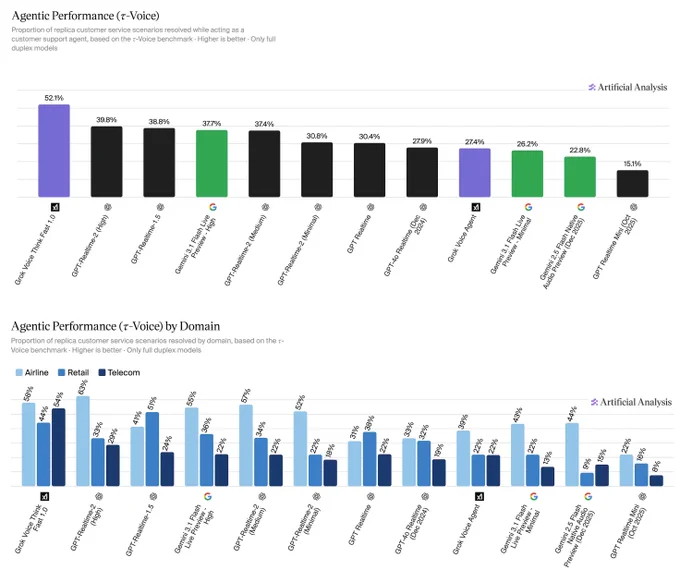
Announcing agentic performance benchmarking for Speech to Speech models on Artificial Analysis. We use 𝜏-Voice to measure tool calling and customer interaction voice agent capabilities in realistic customer service scenarios
Even the strongest Speech to Speech (S2S) models today resolve only about half of realistic customer service scenarios end-to-end - a meaningful gap relative to frontier text-based agents on the same tasks. Voice channels introduce significant complexity: challenging accents, background noise, and packet loss, all while requiring fast responses, consistency across long multi-turn conversations, and reliable tool use. Performance also varies considerably by audio condition: in clean audio some models perform notably better, but realistic conditions continue to pose a challenge. Conversation duration also varies meaningfully across models, with implications for both customer experience and operational cost.
About 𝜏-Voice:
Our Agentic Performance benchmark is based on 𝜏-Voice (Ray, Dhandhania, Barres & Narasimhan, 2026), which extends 𝜏²-bench into the voice modality to evaluate S2S models on realistic customer service tasks. It measures multi-turn instruction following, support of a simulated customer through a complete interaction, and tool use against simulated customer service systems. The simulated user combines an LLM-driven decision model with realistic audio synthesis: diverse accents, background noise, and packet loss modelled on real network conditions.
This complements our Big Bench Audio benchmark measuring intelligence and Conversational Dynamics (Full Duplex Bench subset) benchmark measuring conversational naturalness. Scores are the average of three independent pass@1 trials. We evaluate under realistic audio conditions using the 𝜏²-bench base task split across three domains:
➤ Airline (50 scenarios): e.g., changing a flight, rebooking under policy constraints
➤ Retail (114 scenarios): e.g., disputing a charge, processing a return
➤ Telecom (114 scenarios): e.g., resolving a billing issue, troubleshooting a service problem
Task success is determined by deterministic checks against expected actions and final database state, consistent with the 𝜏²-bench evaluator.
Key results:
xAI's Grok Voice Think Fast 1.0 is the clear leader at 52.1%, averaging 5.6 minutes per conversation, the second-longest overall. OpenAI's GPT-Realtime-2 (High) (39.8%, 3.0 min) and GPT-Realtime-1.5 (38.8%, 4.8 min) follow, with Gemini 3.1 Flash Live Preview - High close behind at 37.7% (3.8 min).
Speech to Speech is a fast evolving modality and we expect movement in rankings as we continue to add new models with these capabilities, and model robustness improves.
Congratulations @xAI @elonmusk! See below for further detail ⬇️
显示更多
Announcing the Artificial Analysis Coding Agent Index! Our new coding agent benchmarks measure how combinations of agent harnesses and models perform on 3 leading benchmarks, token usage, cost and more
When developers use AI to code they’re choosing a model, but also pairing it with a specific harness. It makes sense to benchmark that combination to understand and compare performance.
The Artificial Analysis Coding Agent Index includes 3 leading benchmarks that represent a broad spectrum of coding agent use:
➤ SWE-Bench-Pro-Hard-AA, 150 realistic coding tasks that frontier models struggle with, sampled from Scale AI’s SWE-Bench Pro
➤ Terminal-Bench v2, 84 agentic terminal tasks from the Laude Institute and that range from system administration and cryptography to machine learning. 5 tasks were filtered due to environment incompatibility
➤ SWE-Atlas-QnA, 124 technical questions developed by Scale AI about how code behaves, root causes of issues, and more, requiring agents to explore codebases and give text answers
Analysis of results:
➤ Opus 4.7 and GPT-5.5 lead the Index: Opus 4.7 in Cursor CLI scores 61, followed closely by GPT-5.5 in Codex and Opus 4.7 in Claude Code at 60. GPT-5.5 in Cursor CLI follows at 58.
➤ Open weights models are competitive, but still trail the leaders: GLM-5.1 in Claude Code is the top open-weight result at 53, followed by Kimi K2.6 and DeepSeek V4 Pro in Claude Code at 50. These are strong results, but still meaningfully behind the top proprietary models.
➤ Gemini 3.1 Pro in Gemini CLI underperforms: Gemini 3.1 Pro in Gemini CLI scores 43, well below where Gemini 3.1 Pro sits on our Intelligence Index, highlighting that Gemini’s performance in Gemini CLI remains a relative weak spot for Google’s offering.
➤ Cost per task (API token pricing) varies >30x: Composer 2 in Cursor CLI is cheapest at $0.07/task, followed by DeepSeek V4 Pro in Claude Code at $0.35/task and Kimi K2.6 in Claude Code at $0.76/task. At the high end, GPT-5.5 in Codex costs $2.21/task, while GLM-5.1 in Claude Code costs $2.26/task. For both models this was contributed to by high token usage, and in GPT-5.5’s case by a relatively higher per token cost.
➤ Token usage varies >3x: GLM-5.1 in Claude Code uses the most tokens at 4.8M/task, followed by Kimi K2.6 at 3.7M/task and DeepSeek V4 Pro at 3.5M/task. GPT-5.5 in Codex uses 2.8M tokens/task, substantially more than Opus 4.7 in Claude Code at 1.7M/task. In GLM-5.1’s case, higher token usage, cost and execution time were partly driven by the model entering loops on some tasks.
➤ Cache hit rates remain high but vary materially: Cache hit rates range from 80% to 96% across combinations. Provider routing, harness prompt structure and cache behavior can materially change the economics of running the same model given cached inputs are typically <50% the API price of regular input tokens.
➤ Time per task varies >7x: Opus 4.7 in Claude Code is fastest at ~6 minutes/task, while Kimi K2.6 in Claude Code is slowest at ~40 minutes/task. This is contributed to by differences in average turns per task, token usage and API serving speed. Opus 4.7 had materially lower amount of turns to complete a task than all other models while Kimi K2.6 had the most.
➤ Cursor made real progress with Composer 2: Composer 2 in Cursor CLI scores 48, near the leading open-weight model results, while being the cheapest combination measured at $0.07/task. Cursor has stated Composer 2 is built from Kimi K2.5, showcasing they have made substantial post-training gains.
This is just the start. We are planning to add additional agents (both harnesses and models). Let us know what you would like to see added next.
显示更多





