与「Memory」相关的搜索结果
Memory 贴吧
一个关键词就是一个贴吧,路径全站唯一。
用户
未找到
包含 Memory 的内容

This is how HOUND smells a market.
Market data enters as raw signal.
HOUND normalizes it into a feature vector, projects it across 32 synthetic odor channels, activates 971 receptor slots, generates a scent fingerprint, compares it against memory, then decides what deserves attention.
Market data → Feature encoding → Synthetic odor → 971 receptors → Scent fingerprint → Memory → HOUND response.
The point is not to predict the next candle.
It is to give market behavior another sensory representation, so changes, similarities and unfamiliar patterns become easier to notice.
Try here :
显示更多


Raven 0.2.0 — The Harness of Harnesses, built for RSI. 🐦⬛
One harness can't be best at everything. Raven combines its own specialist harnesses (Research, Code, Design, Oncall) with the agents you already use (Claude Code, Codex and more) into one team.
And it's built for RSI, and not just at the skill level. The whole harness can be rewritten by AI: prompts, policies, strategy code, playbooks. Every sub-harness, including the orchestration layer itself, is its own instance that can be improved.
With Raven you can:
1. Orchestrate many agents as one team. Raven's sub-harnesses and external agents work in one task graph with shared memory across sub-agents, powered by leading orchestration (0.963 Node F1 on the Multi-Agent Orchestration Benchmark).
2. Run long, complex tasks. Oncall and proactive execution keep work going for days, from scientific research loops to shipping a full Godot game.
3. Build vertical agents with RSI. Use Raven's RSI to develop and refine an agent for your domain, and we'll optimize it with you. Experimental for now; reach out to the Raven team(Discord:
More in the video and slides below. Open source, Apache-2.0.
(lots of work made with Raven lives there, and much of this launch's material was made with Raven too)
显示更多


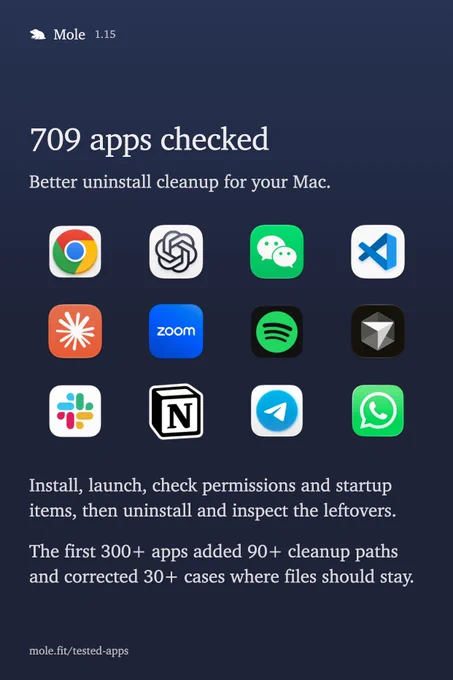
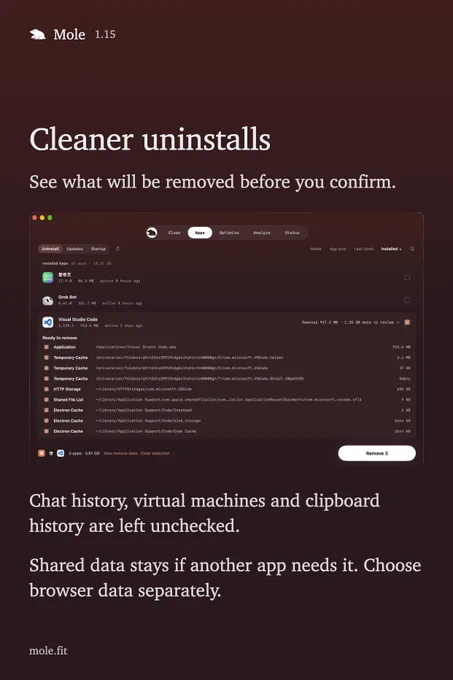
Mole 1.15 is finally here! I tested and inspected 709 Mac apps to improve uninstall cleanup while keeping your files safe 🤯.
CPU and memory usage are also grouped by app now, making it much easier to see what's using your Mac.
Update now
显示更多


The views we shared together… they make up every precious memory I have. ♡
Our little day out 🎀
#ZenlessZoneZero# #Claret# #Roxy# #cosplay# #Vlog#


我从2025年就一直反复强调。
现在所有大学本科生最重要的第一节课,就是买一个最大的coding plan,用上claude code或者codex,
第二节课是自己做一个最最最小版本的coding agent,可以对比codex或者claode code的基本功能,只要能输入一个基本功能,iteratively让agent完成写代码、编译、测试、 运行的功能即可,一切在terminal里,先把terminal和tool calling功能做好,
第三节课是认真观察codex和claude code的基本功能,把里面的memory、skills、multi agent/subagent、background tasks、session管理、context compression、TUI/GUI设计、如何可视化diff、如何管理好额外的btw等等类似的功能、如何把goal的功能放进去、如何实现scheduled tasks、如何实现权限管理等等,一步步一点点摸索实现出来。
我反复讲,一个计算机本科生能看完立党AI研究学习教程,把上面这三节课做完,就已经吊打清华计算机80%以上的本科生了。
显示更多

阿里云开源「企业级 Agent 白皮书」
2026 年最新发布,是 2025 年 9 月「AI 原生应用架构白皮书」的升级续作。全书按 架构 → 构建 → 运行 → 治理 → 调优 的全生命周期组织,共 7 篇 30 章,由阿里云数十位一线工程师分工撰写,并纳入吉利、塔斯汀、MiniMax、哔哩哔哩、信永中和等外部企业案例。
它的写作动机很明确:过去一年市场重心已经从 “如何快速搭出一个 Agent” 转移到三个新挑战,工程化(从概率智能到可靠生产力)、规模化(从单点试验到智能基础设施)、组织化(从 Agent 孤岛到进入核心业务流程)。现有的框架文档和教程基本不回答这些问题,这本白皮书填补的正是这个空白。
开源地址
# 各篇核心内容
架构篇(1–2 章) 建立认知框架。给出 Agentic Application 的六个判定特征(以任务结果为中心、运行时决定部分执行路径、能作用于环境、维持跨请求状态、受确定性机制约束、可观测可评估)和成熟度四级模型(L1 辅助生成 → L2 受控自动化 → L3 Agentic Execution → L4 规模运营)。两个重要的解耦判断:用哪种形态取决于任务结构,处于哪级成熟度取决于治理完备程度;单 Agent / Long-Horizon / 多 Agent 是沿时间跨度和协作结构两个正交维度的扩展,不存在“必须升级到多 Agent”的路径。贯穿的原则是“最低充分架构”,为任务选择成本与风险可接受的最低复杂度。
构建篇(3–6 章) 是方法浓度最高的部分,按“范式—任务—信息—行动”还原构建过程:
· 任务:Agent Loop 五阶段(Prepare→Model→Act→Observe→Verify)+ 十态任务状态机,要害是“消息历史不应是任务状态的唯一来源”;完成判定的核心原则是“模型只能申请完成,Harness 依据环境证据提交完成”,验证分五级并与风险匹配。
· 信息:Context 是动态“编译”而非静态字符串。本章的独创设计是 Context Manifest,每次调用记录上下文每个片段的来源、作用域、版本、信任级别、选中理由和内容哈希,使“模型看见了什么”变得可解释、可回放、可审计。信息被五分为 Context/State/Memory/Knowledge/Skill,其中 Memory(个人经验)与 Knowledge(组织内容)必须分列,因为治理责任不同,“放进同一个向量库会同时失去两类治理能力”。
· 行动:统一 Action Plane(意图→Schema 校验→身份绑定→策略决策→执行→观测),关键三分:“模型看见工具 ≠ Harness 注册了工具 ≠ 获得执行授权”。协议定位清晰:Function Calling 是模型-Harness 意图接口,MCP 是 Harness-能力提供方连接协议,A2A 面向拥有独立任务循环的远程 Agent,“协议选择由能力是否拥有独立任务循环决定,而非新旧或流行度”。
运行篇(7–12 章) 处理规模化后的工程问题,大量内容达到了分布式系统的专业深度:沙箱后端选型判据(容器/gVisor/MicroVM 按代码可信度与租户边界取舍);状态外置后 Event Log / Checkpoint / 工作区快照三者不可互相替代,且“Durable Execution ≠ 外部动作恰好执行一次”;AI 网关对 LLM/MCP/Agent 三类流量按不同粒度治理,其中“严格预算需要原子预留而非阈值检查”的数学化分析(余额 100、两笔 80 的并发请求都会通过)是真实的并发工程细节;多 Agent 编排强调“最小充分共享”,共享的是上下文来源而非同一个 Context 窗口。
治理篇(13–16 章) 让自主运行的系统变得可信。可观测性的判据是“请求成功 ≠ 任务成功”;安全章同时把 Agent 当被攻击对象和行为主体来防护(身份是全章最扎实的部分:数字工牌、Token Exchange 权限收敛、On-Behalf-Of 且 Agent 权限 ≤ 用户权限);资产管理把 Prompt/Skill/MCP/Agent 当作运行时依赖做注册与版本治理。第 16 章 Agent Simulation 是全书原创性最强的一章:Agent 行为之所以不可验证,是缺制度前提(角色无外部标准、失败无自然代价、身份不连续),模拟是当下唯一可做的事,本质是“用可靠 Harness 约束不可靠内核”。它甚至给出诚实的统计学提醒:n 次零违规的 95% 置信上界约为 3/n 而非零。
调优篇(17–24 章) 的组织原则是“归因决定方法”:先排除环境故障、再修 Harness、最后才动模型,“把本应由上下文或工具协议解决的问题当成模型不行,是代价最高的一类误判”。主线是数据飞轮:Trace→Trajectory→黄金数据集(输入/轨迹/结果/判据四要素)→Badcase 闭环→受控自进化(模型生成的改进一律是候选变更,须回流构建、过门禁、可回滚)。模型调优章对 SFT/Agentic RL/蒸馏的适用边界、奖励投机的三套机制分离(训练奖励、独立评测、系统硬约束)论述相当严谨,广引 DeepSeek-R1、Tulu 3、FrugalGPT 等外部工作。
总结篇(第 30 章) 是全书思想密度最高的总结。当企业同时运行多 Agent、多框架、多租户时,同样的工程要求在每个应用里被重复且不一致地实现,这本质上是缺一个共享的系统层。Agentic OS 被给出“窄定义 + 三条否定”:为 Agent 任务提供公共运行对象、能力接入、可强制边界与统一证据的系统层,它不持有任务语义、不是又一个框架、不必然改内核。能力下沉有三条判据(复用性 + 强制性或可验证性),九类管理对象(其中 Budget Lease 预算租约最易被忽略),并提出“自治上限由可撤销范围与可证明范围决定,而非模型能力”。
调研报告 的 1906 份问卷给出一个关键发现:已开发或开发中 Agent 的企业占 46%,但真正上生产的仅 18%;有评估体系的企业任务成功率是无评估者的约两倍,卡点不是模型能力,是 Harness 层的工程配套。这与全书立意互为印证。
显示更多


I've created a new Grok Bot Tutorial template for anyone new to Grok @Bot.
This hands-on course includes 20 lessons. It walks you through every feature step by step, with real exercises and tips so you get the most out of Grok Bot.
Download:
The 20 lessons:
1) Talking to your assistant
2) Files, images, and voice
3) Research & writing
4) Connecting your apps
5) Calendar and scheduling
6) My own computer & browser
7) Working on your own computer
8) Routines
9) Staying in control
10) Privacy and security
11) Memory and preferences
12) Skills
13) Showing it how to do something
14) A team of assistants
15) Sharing and templates
16) Customizing, and fixing things
17) Using it for your job or business
18) Travel and everyday errands
19) Money and finances
20) Buying things for you
显示更多

阿里把团队内部用了两年的官方 AI Code Review Skills 开源了,采用 “确定性工程 pipeline + AI Agent” 的混合架构,专门解决通用 Agent 做代码审查时 “漏审、定位漂移、质量不稳” 的老问题。
40.5K ✨ 开源项目 OpenCodeReview:
# 核心设计:确定性工程 pipeline × Agent 各司其职
确定性工程负责硬约束:
· 精确文件选择:用代码决定哪些文件必须审、哪些要过滤,不依赖模型自觉;
· 智能文件捆绑:把相关文件合成一个审查单元(例如 message_en.properties 和 message_zh.properties 捆绑),每个单元以上下文隔离的 sub-agent 运行,分治策略让超大变更集也稳,且天然支持并发(默认 8 个文件 worker);
· 细粒度规则匹配:内置约 54 个按语言/文件类型的规则文档(Java、Go、TS/JS、Python、Rust、SQL/XML mapper、properties 等),用模板引擎而非自然语言把规则匹配到文件特征上,从源头消除信息噪声;
· 外部定位与反思模块:评论的“落点”和“内容”分别由独立的 re-location 和 reflection 模块系统性校正,这正对“位置漂移”痛点。
Agent 负责动态决策:
· 深度优化的场景 prompt(内部分为 plan → grouping → main → memory_compression → re_location → review_filter 多个任务模板,可在 internal/config/template/prompts/ 看到);
· 从海量生产环境的 tool-call 轨迹(调用频率分布、单工具重复率、新工具对调用链的影响)反向蒸馏出的专用工具集,包括全文件读取、代码搜索、其他变更文件查阅等,比通用 agent 工具箱更小更稳。
# 能力面与生态集成
功能上覆盖:workspace/分支区间/单 commit 审查、断点恢复(ocr session)、全文件 scan(无 git 历史也能审计陌生代码库)、本地 Session Viewer 网页查看与回放、SARIF/JSON 输出、OpenTelemetry 可观测性、MCP Server 扩展。
作为 “Skills 生态” 级项目,它的形态相当完整:既提供 npm 全局 CLI,也提供可移植的 Agent Skill(skills/open-code-review/SKILL.md,带标准 frontmatter,可直接被兼容 skill 的 agent 加载),还有面向 Claude Code、Codex、Cursor、Kimi Code、OpenCode 等平台的插件,每种都封装成斜杠命令或可调用 skill。LLM 侧兼容 OpenAI、Anthropic、AWS Bedrock 三类协议,并可直接复用 Claude Code 的 ANTHROPIC_* 环境变量。
其中一个设计很巧妙:Delegation 模式(ocr delegate preview/rule)。此时 OCR 只做自己擅长的确定性部分(文件选择和规则解析)审查本身交给宿主 coding agent 的 LLM 执行,用户无需给 OCR 配任何 API key。这实际上是把“harness 能力”与“模型能力”彻底解耦。
# 工程质量:超出平均水准的部分
· 安全有正式的 Assurance Case(ASSURANCE_CASE.md):完整的威胁模型、四条信任边界、T1–T7 威胁逐条给出缓解措施,并按 Saltzer & Schroeder 设计原则和 OWASP Top 10 做了映射。细节经得起推敲:所有外部进程调用只限 git 且子命令硬编码、--end-of-options 防 flag 注入;Agent 读文件路径经 pathutil.WithinBase() 在符号链接解析前后双重校验;本地 Viewer 有 Host 白名单防 DNS rebinding + 严格 CSP。这类文档在一般开源项目里非常罕见。
· 贡献规范近乎严苛(AGENTS.md):使用 AI 必须在 issue/PR 中披露工具与模型、必须逐行理解 AI 生成的代码、禁止“AI 生成→反复修复→再修复”的循环、禁止把 commit 署名给 AI。源码强制英文(CI 有 english-check,连全角标点都查)、90% 测试覆盖率门槛、-race 与 govulncheck 每次 push 都跑、SPDX 头与 LF 行尾强制。
# Benchmark:数据情况
官方基准 AACR-Bench(已在 Hugging Face 开放)规模不小:50 个流行开源仓库、200 个真实 PR、10 种语言、80+ 资深工程师交叉验证出 1505 条标注问题。结论是同模型对比 Claude Code:Precision 和 F1 显著更高、token 消耗约为 1/9、速度更快。
需要指出两点:其一,Recall 低于通用 agent,README 自己承认这是“以精度换噪声”的刻意权衡,如果你最怕漏问题而非误报,可能不适合;其二,该基准由阿里自建,虽开放了数据集供社区复核,但独立第三方的复现结论目前还少,可以把它当作“有披露的、方向可信的参考”。
显示更多


🚨 SlowMist TI Alert 🚨
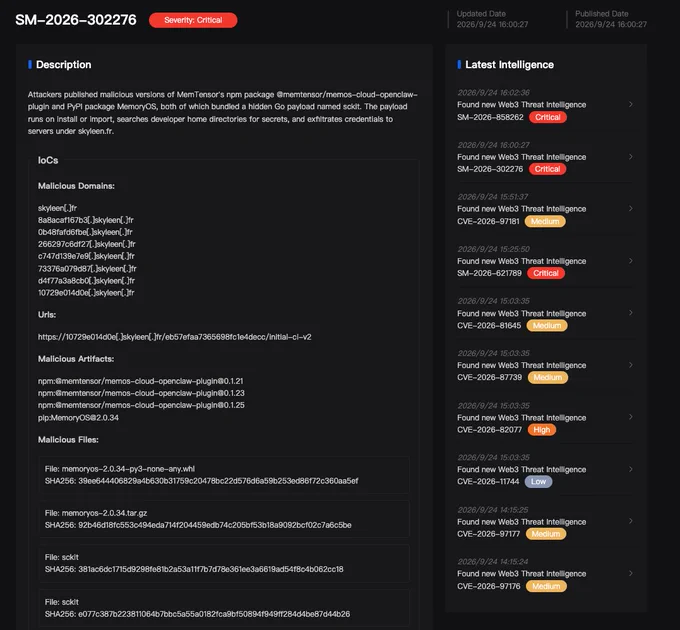
MemTensor's AI memory tooling has been compromised: MemoryOS (PyPI), the company's open-source long-term memory library for LLM and AI agents, and memtensor/memos-cloud-openclaw-plugin (npm), the official plugin connecting it to the OpenClaw agent runtime.
Affected versions bundle cross-platform Go binaries that execute when the package is loaded or imported: MemoryOS==2.0.34 on PyPI, and plugin versions 0.1.21, 0.1.23 and 0.1.25 on npm. You are affected if the PyPI version has been imported in your environment, or if the npm plugin is installed and the OpenClaw gateway has been started.
Potential attacker actions include harvesting npm/PyPI tokens, GitHub/GitLab credentials, AWS keys, SSH keys, API tokens, environment secrets, and other developer credentials, with data sent to infrastructure under skyleen[.]fr. The affected npm plugin may also expose user prompt content.
Users should remove or downgrade affected packages to known-good versions (0.1.20 for npm and 2.0.33 for PyPI), terminate sckit processes, block associated infrastructure, review network activity, and rotate credentials accessible from affected environments.
You can also visit to check for free whether the npm packages, pip packages, domains, or IPs you use are safe.
Reference:
As always, stay vigilant!
显示更多

高盛Rich Privorotsky:Muse只是起点,AI Agent真正要重写的是整个经济的“摩擦成本”
高盛One-Delta交易台负责人Rich Privorotsky现在关注的,已经不只是 $META 的Muse有多火。
他提出了一个更大的判断:
Agentic AI正在开始消除整个经济体系里长期存在的“摩擦”,而这可能带来一次真正的生产率跃升,并形成结构性的去通胀力量。
这可能也是理解下一阶段AI行情最重要的一条线。
过去三年的AI牛市,市场主要交易的是:
训练模型 → GPU → HBM → 数据中心 → 网络 → 电力
而下一阶段,市场开始交易一个完全不同的问题:
当AI真正进入日常经济活动以后,它到底能够替人类省掉多少时间、成本和中间环节?
Muse真正改变的,不只是AI能力,而是“消费者惯性”
很多行业过去能够长期维持较高利润,并不完全因为它们的产品无法替代。
其中一个很重要的原因,是消费者嫌麻烦。
保险续费涨价了,你懒得重新比较几十家公司。
手机套餐贵了,你懒得转运营商。
酒店价格高了,你没有时间每天重新搜索。
订阅服务每个月继续扣钱,你甚至已经忘记自己还在付费。
退款需要打电话、发邮件、等待客服,很多人最后干脆放弃。
这些看似微不足道的事情,实际上构成了一个巨大的隐形经济:
Consumer Inertia——消费者惯性。
过去消费者的时间有限,所以很多公司实际上可以从“麻烦”本身赚钱。
Muse这样的AI Agent正在攻击的,恰恰就是这种摩擦。
如果你的AI可以24小时替你比价、取消订阅、申请退款、重新谈账单、寻找更便宜的保险、比较酒店、订机票甚至完成支付,那么过去建立在消费者“不想折腾”之上的商业模式就可能受到压力。
AI最先消灭的,未必是某一个行业,而是“麻烦”本身。
为什么这可能带来结构性去通胀?
想象一下,当未来几亿甚至几十亿消费者都拥有一个永远不会累、永远愿意比较价格的AI Agent,会发生什么?
保险公司更难依赖客户懒得换公司维持高价格。
旅游平台必须证明自己的佣金真正创造价值。
长期不用的订阅可能被Agent自动取消。
零售商品的价格透明度进一步提高。
企业内部大量重复的行政、客服和后台流程也可能被自动化。
于是经济体系中大量长期存在的成本:
信息差 + 搜索成本 + 时间成本 + 人工成本 + 中间环节
都有可能被压缩。
这就是Privorotsky所说的生产率红利。
过去互联网降低的是信息传播成本。
移动互联网降低的是连接成本。
而Agentic AI下一步可能降低的是:
行动成本。
这可能比单纯推出一个更聪明的大模型,对整个经济的影响更加深远。
所以AI行情可能开始从“卖铲子”走向“生产率革命”
第一阶段的赢家其实非常容易理解。
$NVDA、$AMD、$TSM、$AVGO,以及HBM、网络、光通信、服务器、数据中心和电力基础设施。
因为无论最后哪一个AI模型胜出,都必须先购买算力。
但Agent时代真正有意思的地方,是AI创造的价值可能开始从基础设施向整个经济扩散。
企业可以减少后台人工成本。
客服效率提高。
营销变得更加精准。
库存管理改善。
软件开发周期缩短。
采购和供应链流程自动化。
消费者寻找商品和服务的成本下降。
当这些效率提升逐渐进入企业利润表以后,AI的赢家就不一定永远只集中在半导体。
第一阶段赚的是“建设AI”的钱。
第二阶段赚的可能是“使用AI提高生产率”的钱。
这两轮行情的受益公司可能完全不同。
CPU为什么突然成为Agentic AI的重要交易方向?
这一点也值得特别关注。
过去生成式AI最重要的硬件交易是GPU,因为训练和大规模模型推理高度依赖GPU。
但Agent并不是简单回答一个问题。
它需要打开浏览器、运行操作系统、调用API、处理文件、管理数据库、执行代码、安排任务,甚至同时运行多个Sub-Agent。
这意味着Agent时代增加的不只是模型推理负载。
它还增加了大量传统计算工作负载。
所以市场近期开始重新关注CPU以及整个服务器基础设施。
如果未来不是几百万人偶尔问AI一个问题,而是几亿个Agent每天在后台连续工作几个小时,那么计算需求的结构本身都会发生变化。
这也是为什么现在不能再简单用:
“AI = GPU”
来理解整个产业链。
未来更完整的公式可能是:
AI Agent = GPU + CPU + Memory + Storage + Networking + Power
Agent运行时间越长,需要调用的工具越多,整个数据中心被消耗的资源也就越多。
但市场现在仍然处于非常早期的定价阶段
目前指数很强,但市场宽度并不好。
大量资金依然高度集中在AI和少数大型科技公司。
所以现在看到的更像是三个阶段:
第一阶段:AI基础设施重新定价。
GPU、HBM、网络、数据中心、电力率先上涨。
第二阶段:Agent平台重新定价。
$META 的Muse只是最近最明显的案例之一。
第三阶段:整个经济的生产率重新定价。
如果Agent真正大规模进入企业和消费者生活,受益范围才可能从科技行业逐渐扩散到更广泛的权益市场。
而现在,我们可能刚刚站在第二阶段的入口。
这也是为什么高盛交易台对大盘仍然保持积极观察
Privorotsky的另一个核心观点是,目前市场并不是毫无风险。
季节性仍然存在。
实际利率仍然偏高。
地缘政治风险没有消失。
市场宽度也并不理想。
但另一方面,投资者对这些问题已经非常警惕,仓位和情绪本身并没有进入极端乐观状态。
因此他认为,市场仍存在进一步向上突破的空间。
这里真正值得注意的,不是简单地说“美股一定继续涨”。
而是:
如果Agentic AI开始被市场从一个科技产品故事,重新理解成一场生产率革命,那么它能够支撑的估值范围,就不一定只局限在几家AI芯片公司。
这可能才是下一轮行情真正值得观察的变化。
过去三年,我们一直在问:
谁能提供AI需要的算力?
接下来市场可能开始问:
谁能够利用AI,把自己的收入增长得更快、成本降得更低、利润率做得更高?
而再往后,还有一个更大的问题:
如果Muse只是第一批真正进入大众市场的Agent,当几十亿个AI Agent每天替人类工作、购物、谈价格、管理订阅和完成交易时,今天哪些行业看起来稳定的利润,其实只是建立在“人类嫌麻烦”这件事上?
显示更多