与「monkey」相关的搜索结果
monkey 贴吧
一个关键词就是一个贴吧,路径全站唯一。
用户
未找到
包含 monkey 的内容

if you want to automerge thousands of pull requests , this is how she does it (via @poteto).
809 in june. 10,926 in october. merged prs a month that touch the grok bot team's code.
i went through her posts and put the setup in one place.
every pr still gets an agentic risk review plus bugbot. low- and medium-risk ones automerge. only higher-risk ones get a person.
day to day, in her words, it's just grok bot and cursor projects. she used to have more cursor automations and replaced them with slack bots that have routines.
she works on many streams in parallel with pstack: perf, bug fixes, agent-friendly refactors, her own skills, features, ui polish, the harness, release and observability. not from sitting in a review inbox.
she's said the speed gains come from parallelizing. a single chat can take longer because of verification. she handholds it less, so she can run several large projects at once.
the real setup is in the codebase and the checks around it. she treats the codebase as memory. every agent mistake needs to turn into a constraint. her team built their own framework for grok bot so some anti-patterns become hard to write at all.
agents have to verify their own work. they run the app, and can sometimes model it in tla+. they produce screenshots or video that are easier to check than the whole pr. formal verification skills and ordinary run-and-debug skills work together.
she calls this an inverse pyramid. push as much as you can into determinism (fuzzing, property tests, formal and runtime verification, stricter languages) instead of spinning up more agent swarms.
in her oct 6 post, she tells sandcastle, a grok team bot, to cut. it runs a buildkite dry run, dms every pr author (they can object), kicks the build, and watches it. then it starts a fuzz swarm: usually 10+ agents on grok 4.7 xhigh, some directed, some chaos monkey, using their verification skills and feature map.
when something is high priority, she tells sandcastle to @ mention poteto, her engineer bot, which then spins up a cursor project to triage and fix.
her team ships a new stable version of the client at least once a day.
that's a lot of machinery under "just grok bot and cursor projects."
显示更多


The REAL story finally came out. And THIS is exactly why I waited before jumping on the outrage bandwagon.
Not only had these individuals pulled the same stupid prank in front of FOUR other Ring cameras before reaching this apartment, but BOTH sides have now acknowledged that they didn’t even know each other. The pranksters didn’t even know the race of the people living inside the apartment.
Now these individuals are being threatened, doxxed, and dragged across the internet. One even left the university.
Was the prank stupid? Absolutely. Does that justify what is happening to them now? NOT EVEN CLOSE.
Imagine living in a world where making monkey noises into a Ring camera can potentially land you in more trouble than k*lling your own THREE CHILDREN.
Imagine living in a world where a woman pulled a stupid prank and is forced to step away from her education, but a MURDERER who admitted to k*lling a student at a track meet is not expelled and is allowed to graduate.
The world is backwards.
显示更多


Tens of thousands of offensive engagements, dozens of impactful security findings, no outages or incidents caused so far.
Meet Shopify’s Cyber Chaos Monkey 🐒, our agentic vulnerability hunter.
显示更多


No FUD.
No noise.
Only monkey business. 🐒
If you get it, you’re already one of us.
$MONKEY


AI Drug Discovery Is Becoming a Bottleneck Trade
I get excited when an industry starts going through a real regime change. AI drug discovery (“AIDD”) increasingly looks like one of those moments.
Two things are happening:
1/ Upstream: the frontier AI labs are piling in.
2/ Downstream: The supply chain is clearly moving.
Supply-chain checks suggest the upstream picks-and-shovels of discovery and early preclinical R&D are starting to feel the increase in experimental volume.
DNA → protein → assays → sequencing → automation → preclinical testing
Names across that stack include $TWST , @GenScript , $ILMN , $TXG , lab-automation vendors and CROs.
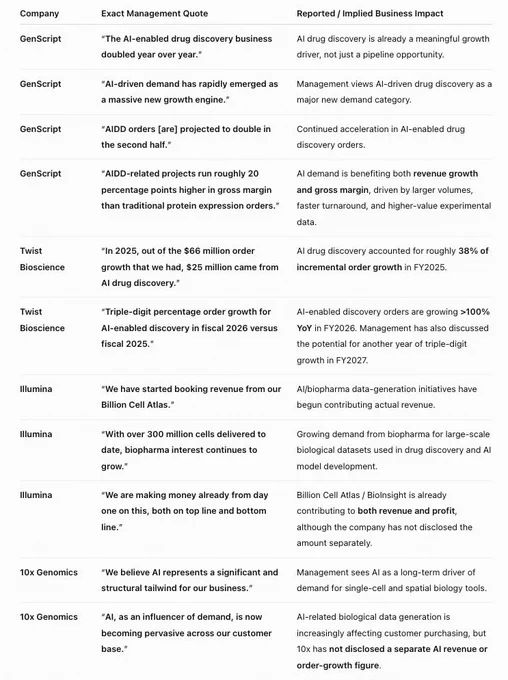
$TWST expects triple-digit percentage growth in AI-enabled drug-discovery orders in FY26, and another year of triple-digit order growth in FY27.
@GenScript's AIDD business doubled YoY in 1H26. Its current platform advertises industrial-scale validation of 4,000+ designs/day, with integrated sequence-to-data workflows. Our channel checks suggest the ramp is moving even faster: roughly 8,000 designs/day currently, with a path toward ~16,000/day by YE26.
---
Why does AI drive more wet-lab demand?
1/ AI makes hypothesis generation almost free → way more shots on goal.
The bottleneck is moving from expert-driven design to biological validation.
2/ AI models need continuous experimental feedback — and both good and bad data are useful.
Traditionally, only the highest-conviction A+ candidates might get pushed into expensive validation. With AI, even the B/C candidates can be valuable because failed experiments generate training data.
@GenScript has said its sequence-to-binding workflow can return data in 4–7 days, and that faster cycle times matter because AI models depend on continuous experimental feedback.
@Anthropic is a clean example. @claudeai designed 1,320 protein binders. @adaptyvbio converted those digital sequences into DNA, expressed the proteins and tested binding. Only 354 actually bound. And the 966 failures are not wasted. They are useful negative labels: what does not express, what does not bind, what has poor affinity. Those results help train the next model iteration.
3/ Wet labs are no longer just making drugs. They are making training data.
$TWST / @GenScript increasingly look like biological data foundries.
$TWST explicitly talks about generating model-ready data from AI-designed sequences. In some workflows, the customer may care less about receiving the physical protein than about getting structured experimental results back into the model.
Traditional drug discovery asks: “Does candidate X work?”
AI drug discovery also asks: “What can this experiment teach the model?”
---
TAM of AIDD
If AI is simply a better R&D tool, the relevant spending pool is the $300–400B of annual global pharma R&D. If AI meaningfully increases the number of viable drug programs, the opportunity is larger because it expands downstream demand for DNA synthesis, protein production, assays, and preclinical work.
Near term, we can also size demand from AI-company spending. If Anthropic reaches $80B of ARR in 2026 and spends just 1% on AIDD, that alone would imply ~$800M of annual investment.
---
Trade setup
This is a trade that could have long legs. It’s hard to really stop working until PhaseI/II results (2028+)
It smells a lot like the bottleneck trade we just saw in semis: GPUs → HBM → networking → power/cooling. In biology, It basically follows the drug discovery process downstream: AI models → designs → DNA/protein → assays → preclinical capacity.
After the upstream picks-and-shovels, animal testing could become the next bottleneck. Monkey prices are already near prior highs and CRO capacity is tight. AIDD pushing more candidates into preclinical development would only add demand.
?? But clinical trials are still the bottleneck?
This is the biggest pushback I keep coming back to. No matter how fast discovery becomes, drugs still need to go through preclinical → Phase I → Phase II → Phase III → approval. You still need patients, time and capital.
But that doesn’t mean the bottleneck trade won’t work. More viable candidates — especially with higher success rates — still means more demand throughout the development process.
And who knows: clinical trials themselves may eventually be optimized by AI.
?? What breaks the trade?
Near term, the picks-and-shovels trade breaks if experimental budgets stop growing, AI-generated designs don’t translate into useful wet-lab hits, or capacity catches up too quickly.
Longer term, the thesis breaks if AI drugs look great in discovery / Phase I but fail at normal rates in Phase II/III. That is why Phase II matters so much.
?? Milestones
Late 2026–2027: first Isomorphic-designed drugs enter human trials; more AI-native programs move into IND-enabling work / tox.
2028–2030: clinical trial results start telling us whether AI-designed drugs actually perform better than conventional drugs.
Calling all the "bottleneck bros". :) @jukan05 @zephyr_z9 @aleabitoreddit @ParadisLabs
+++
More comprehensive analysis:
显示更多


New communities have been added to the whitelist:
@CCFF00club and @MonkeyHoodNFT holders can mint NOW
Public mint opens in less than an hour ⏳
Mint here;


热猴 🐒Hot Monkey,评价一下这段子离谱程度呢 脑洞清奇的丛林绘本故事,还有魔性的片尾旋律,hot monkey 🎵hot monkey 🎶
原作者:@發財客
显示更多


Two wild monkeys approach a rider during traffic jam on a mountain road. The rider tries to scare off them but fails. Tips for you: be careful and calm when coming across wildlife! 😖
Source:Wwwwww(douyin)
显示更多

You’re here because an unbroken chain of your ancestors, from tadpoles to monkeys to now, replicated.
Don’t be the first one to miss the branch.
