与「pilina」相关的搜索结果
pilina 贴吧
一个关键词就是一个贴吧,路径全站唯一。
用户
未找到
包含 pilina 的内容

この度、ライバー事務所《Pilina》を設立しました。
ライバー一人一人の個性や経験を最大限に引き出し、側で支え安心して活動が出来るようにサポートしていきます。
ライブ配信を始めたい方遠慮なくDMにてご連絡下さい☺️🤍
#ライバー事務所#
#ライブ配信#
#pilina#
#TikTok#
显示更多


Multi-agent workflows have a scaling problem!
The agents inside the same workflow rarely need the same amount of capacity at the same time.
Say you have a planner, multiple research agents, and a final synthesis agent.
The planner might finish quickly while requests start piling up behind one of the research agents. Scaling the entire application would add capacity everywhere, even though only one part of the workflow actually needs it.
CanyonOS is an open-source, workflow-aware platform for multi-agent Python applications and the harness between your agents.
Each agent runs as a separate service with its own queue and replica limits, so the busy research agent can get additional capacity while the planner and synthesis agents stay where they are.
It also handles communication between the agents and gives you visibility into what happens across the workflow after a request comes in.
CanyonOS records the path a request took, including the agents it called, parallel branches, model usage, execution time, and estimated model costs.
And you don't need to add tracing decorators or a separate instrumentation SDK throughout your agent code. You still integrate the workflow with CanyonOS, but tracing is handled at the platform layer.
I also ran a multi-agent portfolio analysis workflow through it with separate agents working across three stocks.
A single request produced 10 traceable steps across the workflow, and I could see which agents ran, where the LLM calls happened, how long each stage took, and the estimated model cost.
For multi-agent applications, being able to operate each agent independently while still seeing the complete execution path becomes much more useful as the workflow grows.
CanyonOS is open source. Link to the GitHub repo in the comments!
显示更多


AI Drug Discovery Is Becoming a Bottleneck Trade
I get excited when an industry starts going through a real regime change. AI drug discovery (“AIDD”) increasingly looks like one of those moments.
Two things are happening:
1/ Upstream: the frontier AI labs are piling in.
2/ Downstream: The supply chain is clearly moving.
Supply-chain checks suggest the upstream picks-and-shovels of discovery and early preclinical R&D are starting to feel the increase in experimental volume.
DNA → protein → assays → sequencing → automation → preclinical testing
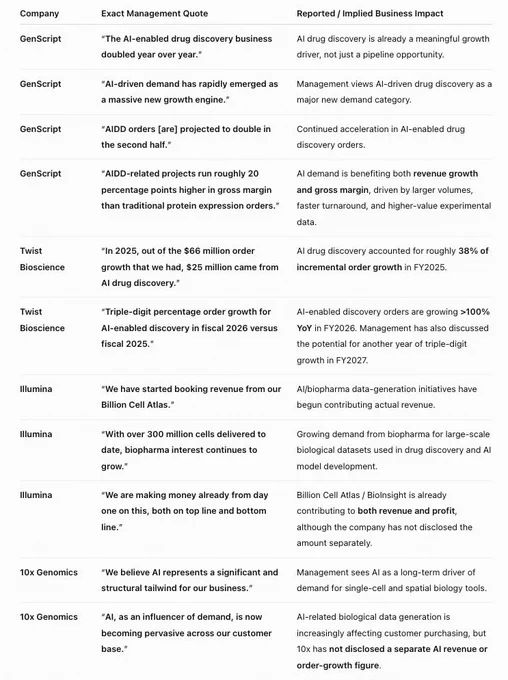
Names across that stack include $TWST , @GenScript , $ILMN , $TXG , lab-automation vendors and CROs.
$TWST expects triple-digit percentage growth in AI-enabled drug-discovery orders in FY26, and another year of triple-digit order growth in FY27.
@GenScript's AIDD business doubled YoY in 1H26. Its current platform advertises industrial-scale validation of 4,000+ designs/day, with integrated sequence-to-data workflows. Our channel checks suggest the ramp is moving even faster: roughly 8,000 designs/day currently, with a path toward ~16,000/day by YE26.
---
Why does AI drive more wet-lab demand?
1/ AI makes hypothesis generation almost free → way more shots on goal.
The bottleneck is moving from expert-driven design to biological validation.
2/ AI models need continuous experimental feedback — and both good and bad data are useful.
Traditionally, only the highest-conviction A+ candidates might get pushed into expensive validation. With AI, even the B/C candidates can be valuable because failed experiments generate training data.
@GenScript has said its sequence-to-binding workflow can return data in 4–7 days, and that faster cycle times matter because AI models depend on continuous experimental feedback.
@Anthropic is a clean example. @claudeai designed 1,320 protein binders. @adaptyvbio converted those digital sequences into DNA, expressed the proteins and tested binding. Only 354 actually bound. And the 966 failures are not wasted. They are useful negative labels: what does not express, what does not bind, what has poor affinity. Those results help train the next model iteration.
3/ Wet labs are no longer just making drugs. They are making training data.
$TWST / @GenScript increasingly look like biological data foundries.
$TWST explicitly talks about generating model-ready data from AI-designed sequences. In some workflows, the customer may care less about receiving the physical protein than about getting structured experimental results back into the model.
Traditional drug discovery asks: “Does candidate X work?”
AI drug discovery also asks: “What can this experiment teach the model?”
---
TAM of AIDD
If AI is simply a better R&D tool, the relevant spending pool is the $300–400B of annual global pharma R&D. If AI meaningfully increases the number of viable drug programs, the opportunity is larger because it expands downstream demand for DNA synthesis, protein production, assays, and preclinical work.
Near term, we can also size demand from AI-company spending. If Anthropic reaches $80B of ARR in 2026 and spends just 1% on AIDD, that alone would imply ~$800M of annual investment.
---
Trade setup
This is a trade that could have long legs. It’s hard to really stop working until PhaseI/II results (2028+)
It smells a lot like the bottleneck trade we just saw in semis: GPUs → HBM → networking → power/cooling. In biology, It basically follows the drug discovery process downstream: AI models → designs → DNA/protein → assays → preclinical capacity.
After the upstream picks-and-shovels, animal testing could become the next bottleneck. Monkey prices are already near prior highs and CRO capacity is tight. AIDD pushing more candidates into preclinical development would only add demand.
?? But clinical trials are still the bottleneck?
This is the biggest pushback I keep coming back to. No matter how fast discovery becomes, drugs still need to go through preclinical → Phase I → Phase II → Phase III → approval. You still need patients, time and capital.
But that doesn’t mean the bottleneck trade won’t work. More viable candidates — especially with higher success rates — still means more demand throughout the development process.
And who knows: clinical trials themselves may eventually be optimized by AI.
?? What breaks the trade?
Near term, the picks-and-shovels trade breaks if experimental budgets stop growing, AI-generated designs don’t translate into useful wet-lab hits, or capacity catches up too quickly.
Longer term, the thesis breaks if AI drugs look great in discovery / Phase I but fail at normal rates in Phase II/III. That is why Phase II matters so much.
?? Milestones
Late 2026–2027: first Isomorphic-designed drugs enter human trials; more AI-native programs move into IND-enabling work / tox.
2028–2030: clinical trial results start telling us whether AI-designed drugs actually perform better than conventional drugs.
Calling all the "bottleneck bros". :) @jukan05 @zephyr_z9 @aleabitoreddit @ParadisLabs
+++
More comprehensive analysis:
显示更多


Hidup cuma sekali, jadi wajar kalau kita pernah salah paham, salah pilih, atau salah mikir. Ga ada orang yang langsung benar dari awal. Kadang kita baca situasi keliru, kadang ikut perasaan yang ternyata nggak pas, kadang ambil keputusan yang baru keliatan akibatnya belakangan. Yang penting bukan pura-pura ga pernah salah, tapi sadar, belajar, lalu dibenerin. Itu cara kita tanggung jawab sama hidup sendiri.
Jangan takut sama akibatnya. Setiap pilihan memang ada harga yang harus dibayar, entah waktu, perasaan, atau kesempatan yang sudah lewat. Tapi akibat itu bukan akhir. Kamu ga sendirian. Banyak orang juga pernah di posisi yang sama, cuma ga semua mau cerita. Yang bikin berat biasanya bukan salahnya, tapi rasa mau disembunyiin terus sampai jadi beban sendiri.
Tarik napas, perbaiki pelan-pelan, lalu jalan lagi. Ga harus langsung beres dalam semalam. Cukup benahi yang masih bisa dibenahi, minta maaf kalau memang perlu, lalu jangan ulang hal yang sama. Hidup ga nunggu kita sempurna. Hidup cuma nunggu kita berani lanjut, dengan diri yang sedikit lebih jujur dari kemarin.
显示更多


5️⃣ Binance Open Interest & Funding Rate
Are traders piling in or pulling out? Track Open Interest, Funding Rates, and futures alongside spot to see the bigger picture.
显示更多


WaterX Predict Festival
A month of predictions. A month of chests piling up. Powered by @SuiNetwork.
🔹 Jul 7 – Aug 7
🔹 The more days you predict, the more and better chests you get
🔹 Earn USD rewards of up to 10% of your volume on each trade
Start now:
显示更多


Your kids are retarded while you pay higher taxes because Democrats bought the teachers unions as a permanent ally to stay in power.
Jimmy Carter created the Department of Education just to lock in the NEA’s first ever presidential endorsement. That’s it. He just wanted their votes.
Democrats protect the monopoly by killing real school choice, piling on federal mandates that bloat the bureaucracy, and pushing trillions through a system built to resist accountability.
In return, the unions deliver the votes, ground game, and hundreds of millions in political spending with some 98% routinely going to Democrats.
Democrats give taxpayer money to the unions and then the unions launder it back to the Democrats’ election campaigns. Taxpayer-funded Democratic party campaigns, basically.
From 2000 to 2017, school district admin staff grew 75% while teachers grew just 8%.
Non-teaching staff now make up nearly half the workforce. That explosion creates more dues paying jobs and political muscle while shielding the whole thing from competition.
The alliance keeps the power. Unions and Democrats get the resources and the jobs. Your kids and your wallet get the bill. That is limited options and stagnant results.
And the best thing is that the Republicans watched it happen for decades and did nothing.
显示更多


Retail investors are piling in to SpaceX stock:
Over the last 2 trading sessions, retail investors bought nearly as much SpaceX, $SPCX, as every other US single stock combined in the entire prior week, according to Vanda Research data.
On Monday alone, retail purchased +$93.8 million of $SPCX shares, accounting for ~73% of all retail single-stock purchases during the day.
In the first 10 minutes of Monday’s session, retail investor turnover in the stock exceeded $7 million.
Individual investors also bought some semiconductor stocks such as Marvell $MRVL, Micron $MU, SanDisk $SNDK, and Broadcom $AVGO.
Retail appetite for risk shows no signs of slowing.
显示更多


Tech, climate and science geeks, this one's for you.
Pilita Clark, Clive Cookson and John Thornhill select their best mid-year reads:


LATEST: 📊 Ethereum short sellers could face a $2B squeeze near $2,000, as rising open interest and positive funding rates show traders piling in on both sides.

