qinbafrank (@qinbafrank) “AI制药赛道(AIDD)的"瓶颈交易"正在成形,Freda Duan这篇推文值得好好看看,梳理下要” — TopicDigg


qinbafrank
@qinbafrank
加入 December 2020
0 正在关注 0 粉丝
AI制药赛道(AIDD)的"瓶颈交易"正在成形,Freda Duan这篇推文值得好好看看,梳理下要点。
前沿AI实验室的集体入场是最显著的信号:1)Anthropic组建了专属生命科学研究团队并建立湿实验室;
2)OpenAI 建立了专为生物学和药物发现设计的 GPT-Rosalind 模型族;
3)字节跳动旗下独立运营的 Anew Labs 已拥有内部药物研发库;
4)同构实验室(Isomorphic Labs)则明确表示将把 AI 设计的药物推进人体临床试验。
与此同时供给端的信号也很清晰:
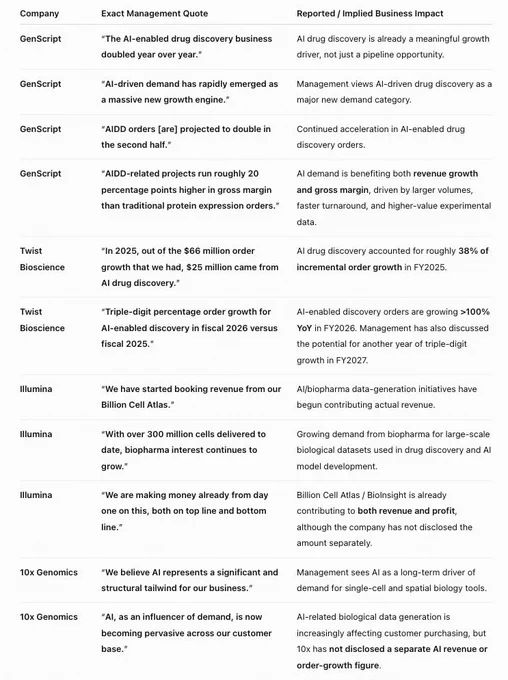
1)DNA 合成商拓斯达生物(Twist Bioscience,TWST)预计2026财年和2027财年的AI药物发现订单将连续实现三位数百分比增长;
2)金斯瑞(GenScript)的 AI 药物发现业务在 2026 财年上半年同比翻倍,渠道调研显示其实际验证产能已达每日约8,000个设计,并有望在 2026 年底前提升至 16,000 个。
AI制药正在形成类似半导体"瓶颈交易"的结构性机会。核心逻辑在于:AI让失败实验也变成有价值的训练数据,湿实验室正从"造药"转型为"造数据",DNA合成、蛋白生产、CRO或成最先受益的"卖铲人"。
在AI制药领域,瓶颈同样在沿产业链向下传递:AI模型产生设计→DNA合成→蛋白生产→实验验证→临床前测试,每个环节都可能成为下一个受益节点。
洛杉矶加州大学教授Quanquan Gu认为:生物学可能成为AI下一个递归自我改进的前沿——在计算机中设计,在实验室中测试,将实验反馈转化为半合成训练数据,改进模型,周而复始。
看来AI-bio值得好好研究下了。
显示更多

AI Drug Discovery Is Becoming a Bottleneck Trade
I get excited when an industry starts going through a real regime change. AI drug discovery (“AIDD”) increasingly looks like one of those moments.
Two things are happening:
1/ Upstream: the frontier AI labs are piling in.
2/ Downstream: The supply chain is clearly moving.
Supply-chain checks suggest the upstream picks-and-shovels of discovery and early preclinical R&D are starting to feel the increase in experimental volume.
DNA → protein → assays → sequencing → automation → preclinical testing
Names across that stack include $TWST , @GenScript , $ILMN , $TXG , lab-automation vendors and CROs.
$TWST expects triple-digit percentage growth in AI-enabled drug-discovery orders in FY26, and another year of triple-digit order growth in FY27.
@GenScript's AIDD business doubled YoY in 1H26. Its current platform advertises industrial-scale validation of 4,000+ designs/day, with integrated sequence-to-data workflows. Our channel checks suggest the ramp is moving even faster: roughly 8,000 designs/day currently, with a path toward ~16,000/day by YE26.
---
Why does AI drive more wet-lab demand?
1/ AI makes hypothesis generation almost free → way more shots on goal.
The bottleneck is moving from expert-driven design to biological validation.
2/ AI models need continuous experimental feedback — and both good and bad data are useful.
Traditionally, only the highest-conviction A+ candidates might get pushed into expensive validation. With AI, even the B/C candidates can be valuable because failed experiments generate training data.
@GenScript has said its sequence-to-binding workflow can return data in 4–7 days, and that faster cycle times matter because AI models depend on continuous experimental feedback.
@Anthropic is a clean example. @claudeai designed 1,320 protein binders. @adaptyvbio converted those digital sequences into DNA, expressed the proteins and tested binding. Only 354 actually bound. And the 966 failures are not wasted. They are useful negative labels: what does not express, what does not bind, what has poor affinity. Those results help train the next model iteration.
3/ Wet labs are no longer just making drugs. They are making training data.
$TWST / @GenScript increasingly look like biological data foundries.
$TWST explicitly talks about generating model-ready data from AI-designed sequences. In some workflows, the customer may care less about receiving the physical protein than about getting structured experimental results back into the model.
Traditional drug discovery asks: “Does candidate X work?”
AI drug discovery also asks: “What can this experiment teach the model?”
---
TAM of AIDD
If AI is simply a better R&D tool, the relevant spending pool is the $300–400B of annual global pharma R&D. If AI meaningfully increases the number of viable drug programs, the opportunity is larger because it expands downstream demand for DNA synthesis, protein production, assays, and preclinical work.
Near term, we can also size demand from AI-company spending. If Anthropic reaches $80B of ARR in 2026 and spends just 1% on AIDD, that alone would imply ~$800M of annual investment.
---
Trade setup
This is a trade that could have long legs. It’s hard to really stop working until PhaseI/II results (2028+)
It smells a lot like the bottleneck trade we just saw in semis: GPUs → HBM → networking → power/cooling. In biology, It basically follows the drug discovery process downstream: AI models → designs → DNA/protein → assays → preclinical capacity.
After the upstream picks-and-shovels, animal testing could become the next bottleneck. Monkey prices are already near prior highs and CRO capacity is tight. AIDD pushing more candidates into preclinical development would only add demand.
?? But clinical trials are still the bottleneck?
This is the biggest pushback I keep coming back to. No matter how fast discovery becomes, drugs still need to go through preclinical → Phase I → Phase II → Phase III → approval. You still need patients, time and capital.
But that doesn’t mean the bottleneck trade won’t work. More viable candidates — especially with higher success rates — still means more demand throughout the development process.
And who knows: clinical trials themselves may eventually be optimized by AI.
?? What breaks the trade?
Near term, the picks-and-shovels trade breaks if experimental budgets stop growing, AI-generated designs don’t translate into useful wet-lab hits, or capacity catches up too quickly.
Longer term, the thesis breaks if AI drugs look great in discovery / Phase I but fail at normal rates in Phase II/III. That is why Phase II matters so much.
?? Milestones
Late 2026–2027: first Isomorphic-designed drugs enter human trials; more AI-native programs move into IND-enabling work / tox.
2028–2030: clinical trial results start telling us whether AI-designed drugs actually perform better than conventional drugs.
Calling all the "bottleneck bros". :) @jukan05 @zephyr_z9 @aleabitoreddit @ParadisLabs
+++
More comprehensive analysis:
显示更多